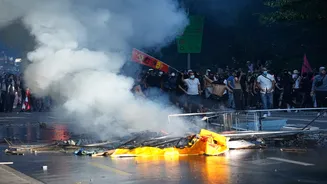









New Delhi: Thousands of demonstrators took to the streets of Geneva on Sunday to protest against the Group of Seven (G7) summit, but the march turned violent
when a section of protesters torched a Tesla vehicle, smashed windows at a United Nations office and confronted police. Authorities responded with tear gas as clashes escalated in parts of the Swiss city. The protest came a day before the start of the G7 Summit in nearby Evian-les-Bains, France.
Protest turns violent as police deploy tear gas
The demonstration initially began as a largely peaceful gathering against capitalism, global inequality and the influence of wealthy nations. However, tensions rose as some protesters targeted symbols they associated with wealth and power.
According to police and media reports, a Tesla vehicle was set ablaze while windows at a UN office were shattered. Protesters also ripped bricks from the street and threw them at police officers. Swiss authorities deployed tear gas to disperse crowds and restore order. Organisers said the protest was aimed at drawing attention to issues such as economic inequality, social justice and gender rights, while some participants criticised the heavy police presence in the city.
The G7 Summit and its opposition
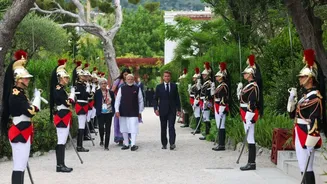
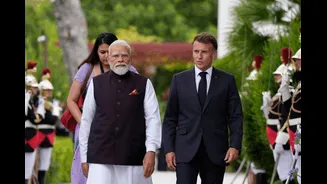
The 52nd G7 Summit is being held from June 15 to June 17 in Evian-les-Bains, France. The grouping brings together leaders of the United States, Canada, Britain, France, Germany, Italy and Japan, along with representatives of the European Union. Several partner countries, including India, have also been invited.
Major discussions this year are expected to focus on conflicts in Ukraine and the Middle East, global security, energy markets, economic resilience and international cooperation. The summit comes at a time of heightened geopolitical tensions across the world, be it the seemingly unending Russia-Ukraine war or the crisis in West Asia which has shaken the global economy. This makes this year’s G7 summit one of the most closely watched international gatherings of the year.
The protests in Geneva however reflect a long-standing opposition among activist groups who argue that decisions made by powerful economies like the G7 are often symbolic of a corrupt upper level rot and fail to address wider social and environmental concerns that affect people of marginalised communities around the war.