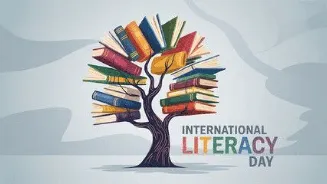









New Delhi: Every year, September 8 serves as a reminder that the ability to read and write is more than an educational milestone – it can shape a person’s
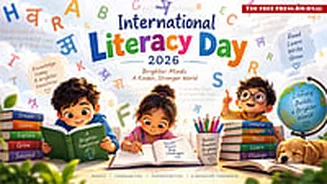
access to jobs, information, healthcare, rights and opportunities. As the world marks International Literacy Day 2026, the focus is on how literacy can help build more inclusive societies while supporting sustainable development and economic prosperity.
The 2026 observance is particularly significant as it marks 60 years since UNESCO proclaimed International Literacy Day. The global celebration is being held on September 8 and 9 in Chiapas, Mexico, in collaboration with the Government of Mexico. The programme brings together education ministers, experts, teachers and students and includes the presentation of the 2026 UNESCO International Literacy Prizes.
International Literacy Day 2026 theme
The theme for this year is “Literacy for People, Planet and Prosperity.”
According to UNESCO, the theme highlights literacy’s role in promoting inclusion, supporting sustainable futures and expanding opportunities for livelihoods and economic development. The 60th anniversary also provides an opportunity to assess progress made over the past six decades and examine persistent and emerging challenges in a rapidly changing world.
The theme comes at a crucial juncture. While literacy rates have improved considerably worldwide, millions of young people and adults remain excluded from basic reading and writing skills.
International Literacy Day 2026: Key statistics
UNESCO estimates that at least 739 million young people and adults worldwide still lack basic literacy skills, based on 2024 data. Women account for around two-thirds of adults without basic literacy skills.
At the same time, global progress is evident. More than 88% of the world’s adult population can now read and write, compared with about 65% in 1975, according to UNESCO. Yet significant gaps remain, particularly among disadvantaged and marginalised populations.
The challenge also begins early: UNESCO says four in 10 children in low- and middle-income countries are not reaching minimum proficiency in reading.
International Literacy Day: History
International Literacy Day was proclaimed by UNESCO in 1966 during its 14th General Conference. The first celebrations were held in 1967, and September 8 has since been observed annually around the world.
The day was established to draw attention to the importance of literacy for individuals, communities and societies and to encourage efforts to advance literacy as a fundamental human right.
Over the decades, the understanding of literacy has also evolved. It is no longer viewed solely as the ability to read and write. Literacy is increasingly connected with lifelong learning, participation in society, employment, digital skills and the ability to navigate an information-rich world.
Why is International Literacy Day important
UNESCO describes literacy as a fundamental human right and a foundation for accessing other rights and opportunities. It can contribute to greater participation in the labour market, poverty reduction, improved health and nutrition, social inclusion and lifelong learning.
For millions of people, however, barriers such as poverty, gender inequality, displacement, limited access to education and social marginalisation continue to restrict opportunities to acquire basic literacy skills.
Literacy in a changing digital world
The meaning of literacy is also changing rapidly. Digital technologies have transformed how people read, communicate, work and access information. As a result, literacy today increasingly intersects with digital, media and information skills.
The challenge is therefore not simply to increase the number of people who can read and write, but to ensure that learners can use those skills meaningfully in their everyday lives and adapt to changing social and economic environments.
International Literacy Day 2026: What lies ahead
The 60th anniversary is both a milestone and a call to action. UNESCO says the 2026 observance will celebrate progress while identifying remaining challenges and highlighting effective policies, practices and partnerships that can advance literacy for all.
As the world observes International Literacy Day, its central message remains as relevant as ever: literacy is not simply about knowing how to read a page or write a sentence. It is about having the knowledge and skills to participate, make informed choices and build a better future — for people, the planet and prosperity.