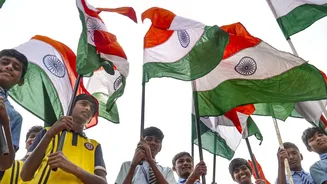



New Delhi: As we celebrate seventy-six years of being a republic, it is an appropriate time and moment to reflect on the road traversed and the journey
ahead. The journey has had its many `exhilarating highs` and `agonizing lows`. While we have built on our strengths we have also had to deal with several missed opportunities. The `balance sheet` of the Indian Republic accounts for many prized assets even as we need to deal with debilitating liabilities. This narrative would not so much focus on the past but look at the multiple opportunities as we move ahead. Our Republic at 76, has a reasonably young population. Estimates indicate that more than four of every ten Indian citizens are born in the 21st century. This indicates that they have experienced living in an India after half a century of it becoming a republic! This new generation of Indians is increasingly digitally savvy, highly aspirational and forward looking. Shaping their `future passage of discovery` would be a key mission of the republic.
As a student of politics, one would choose the vantage lens of social dynamics and political processes to map the contemporary trends in our voyage as a republic and the portends for the future. On Republic Day we normally focus on two dimensions. Firstly, we celebrate having inaugurated a political process in which the Head of State and First Citizen of India (the President) is elected and not a hereditary or nominated position. This was a crucial departure from the past. Secondly, we cherish the launch and inauguration of independent India’s Constitution. This Constitution represents the road that `We the People` chose to accept , outlining the key features of the political architecture for the future. This framework merits detailed elaboration.
The political architecture that the constitution outlines (in its original form) defines the country as a Sovereign, Democratic Republic. Later in 1976, the 42nd Amendment, added the words Socialist and Secular. All five words require to be assessed for clarity on the way forward. Our being a sovereign nation became a reality with our independence. The issue that arises today is the impact of the process of globalisation on our inter-connectedness with the rest of the world. As the impact of globalisation is uneven and varies across different social sectors – peoples` experience of globalisation varies. Along with the digital revolution, one is a witness to the blurring of boundaries and the possibilities of greater direct connections between people and mobility of people, across the world. Under globalisation, the world is not just a collection of countries, but a unique space by itself. As one notices the tariff wars and the impact of the `world wide web`, the sovereignty of nations assumes new and important dimensions.
We cherish our presence in the community of nations as the largest democracy in the world. This democracy has seen very high voter participation in successive elections. The clear articulation of the popular mandate has been witnessed, leading to the assertion that the victor in every election is the `Voter of India`. Yet, the question needs to be raised whether we are increasingly becoming an `election only` democracy. In this mansion of democracy, which needs to have several windows that are wide open, is the window of elections the one always in the spotlight of attention. Do we need to do more to open up the other windows and allow citizen participation and involvement through them also? The 21st century generation appears to be keen to access innovative forms of involvement and participation. Democracy as a framework of meaningful empowerment and constructive engagement appears to be the mission that the Indian republic needs to focus on in the coming days.
As a Republic, taking the spirit of popular participation to the grassroots would be yet another pathway that needs attention. Our federal structure is not just about the centre and the states but the wide array of local bodies that we have. Much of the talk of meaningful decentralisation is often limited to seeking greater autonomy from the higher level of government but not necessarily passing it on to the next level. While states are constantly seeking greater fiscal autonomy the same does not seem to be guaranteed to the local government. This is in spite of the fact that the 73rd and 74th amendment to the constitution empowering local bodies was passed more than three decades ago.
The last two words that define our political architecture and constituted a later day edition, are Secular and Socialist. There has been a debate in some sections of the society to re-look at the relevance of the two words. The challenge which people face with the two words is linked to the multiple interpretations of the two terms and not essentially their underlying philosophical underpinning. The word `secular` first. As a facilitator, I have always found it intriguing that if I were to ask a group of people (either students in the class or participants in a training workshop) to define secular in a single sentence (of not more than 25 words), we would have as many definitions as there are participants. For a country like India, the core idea as we go forward needs to be the acceptance and celebration of religious diversity, respect (not mere tolerance) of all religious faiths and our fundamental identity being that of a citizen of India.
The word `socialist ` needs to be used in its modern context and not in its historical roots. As a nation and a people committed to justice, reducing the gap between the rich and the poor and striving towards equal opportunities needs to be the mantra. There could be multiple pathways to reducing the economic gap between sections of society ranging from greater competition, opening up of the markets and economy and the state providing a social safety net for those requiring the same.
As we begin the 77th year of our journey as a Republic, rededicating ourselves to the true spirit of the political architecture of India as outlined in the Constitution would be an important step forward.