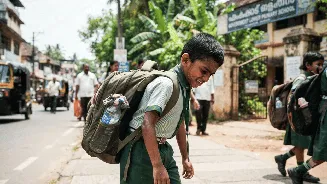








New Delhi: The Kerala General Education Department has drawn up a preliminary action plan to limit school bag weight to under 10 per cent of a student’s
body weight, starting with a pilot rollout in selected lower primary schools from the 2027-28 academic year, according to an official statement.
The framework was discussed at a high-level review meeting chaired by General Education Minister N Samsudheen on Tuesday, November 24. Under the proposed timeline, the initiative will begin in selected institutions equipped with basic infrastructure and digital facilities before expanding to all lower primary and upper primary schools across the state within four years, officials said.
Fewer daily subjects and dual textbook sets
To ensure students do not have to carry all their books to school every day, the department is examining several structural adjustments to daily classroom routines. Key proposals include limiting daily timetables to three or four subjects, providing two sets of textbooks so that one copy stays at school and another at home, and printing textbooks with lessons divided into monthly or half-yearly modules.
Officials also discussed using smart boards to display textbook content during lessons, alongside ensuring clean drinking water and midday meals on school campuses so children do not need to carry extra supplies from home.
Panel to assess implementation
A joint committee comprising the directors of the State Council of Educational Research and Training (SCERT), Kerala Infrastructure and Technology for Education (KITE), General Education, and Samagra Shiksha Kerala has been tasked with evaluating the feasibility of the proposals and submitting follow-up recommendations.
According to the department, the policy push follows an Assembly submission in October by CPI legislator K K Valsaraj, who flagged physical strain and spinal health concerns raised by students in his Kaipamangalam constituency over heavy backpacks. State-level awareness campaigns involving parents, teachers, and students up to the Plus Two level will also be conducted alongside the rollout, with support from the Health and Local Self-Government departments.