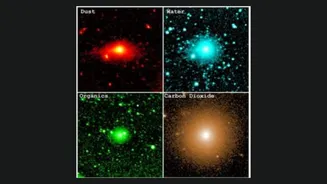








New Delhi: Scientists have examined the interstellar comet 3I/Atlas using the James Webb Space Telescope, which is capable of investigating the chemical
inventory on the object. In October 2025, 3I/Atlas looped around the Sun, and is now on its way out of the Solar System. The kilometre-wide comet is composed of dust and ices from the distant planetary system where it originated. The observations help scientists better understand the alien environment in which the comet was formed. The comet has been travelling through the galaxy for at least a billion years, and scientists have only a short window to study the object during its brief visit.
In the infancy of the solar system, countless planetesimals, or smaller clumps of rock and ice coalesced together to from the Earth and other planets. 3I/Atlas is such a planetesimal that was ejected out of its origin system. It contains different ratios and compositions of chemical compounds than the objects in our own Solar System. Studying the composition of 3I/Atlas allows scientists to better understand where it formed in its origin system. The surface of the comet has been irradiated by cosmic rays for at least a billion years, so the most volatile surface ices such as methane were only outgassed weakly as it approached Earth.
Webb to study comet at least once more
However, after being warmed by the Sun, the comet began emitting methane, indicating that the comet had shed its ancient outer layer and had started to melt its inner layers. This means that the observations revealed the bulk composition of the interior of the object, and not just the chemistry of the outermost irradiated layers. Webb will turn its sensitive infrared gaze towards the comet once again later in the year. The comet is already out past the orbit of Jupiter, and is challenging to observe. A paper describing the research has been published in the Astrophysical Journal Letters. The team will also be reporting the dust composition of the comet in a forthcoming paper.