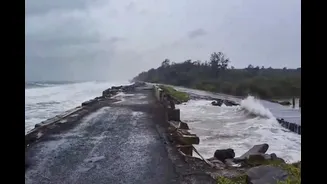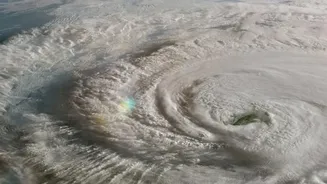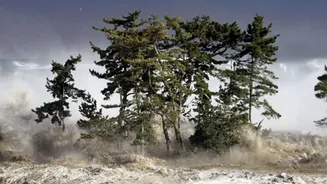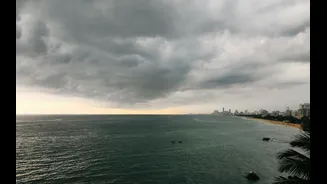







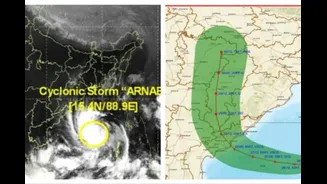
Amaravati: Cyclone Arnab made landfall along the Andhra Pradesh coast early on Wednesday morning, leaving a trail of destruction in its wake. The very
severe cyclonic storm crossed the Andhra Pradesh–Yanam coast between 2 am and 8 am before weakening into a severe cyclonic storm.
In a statement, the India Meteorological Department (IMD) said the cyclone crossed the coast southwest of Yanam, near latitude 16.45°N and longitude 81.90°E. The storm’s centre was approximately 20 km east-northeast of Narsapur, 40 km southwest of Yanam and 60 km southwest of Kakinada. Several coastal districts also received heavy rainfall.
Cyclone Arnab leaves behind a trail of destruction
Following landfall, Cyclone Arnab caused damage across the affected areas, uprooting trees and bringing down electricity poles. Andhra Pradesh Chief Minister N Chandrababu Naidu directed state government officials to take steps to restore normalcy in the affected areas.
Two people were reportedly electrocuted in separate incidents. The circumstances surrounding the incidents and the official casualty figures should be confirmed with the relevant authorities before publication.
Cyclone Arnab is the first cyclone of 2026 to develop over the North Indian Ocean basin, according to reports. The system began as a low-pressure area over the Bay of Bengal on October 23 and intensified over the following days, eventually developing into a very severe cyclonic storm by October 27. It subsequently weakened to a severe cyclonic storm as it crossed the coast, according to The Indian Express.
While the coastal regions of Odisha and West Bengal are highly vulnerable to cyclones originating over the Bay of Bengal, Andhra Pradesh and Tamil Nadu also face significant cyclone risks.
Is El Niño influencing Cyclone Arnab?
The El Niño phenomenon is associated with the abnormal warming of surface waters in the central and eastern equatorial Pacific Ocean. It can influence global weather patterns, including rainfall and temperature, although its effects vary by region and season.
However, establishing whether El Niño contributed to the formation or intensification of Cyclone Arnab requires further scientific evidence. The development and strength of tropical cyclones also depend on factors such as sea-surface temperatures, atmospheric moisture, wind shear and large-scale atmospheric circulation.
The relationship between El Niño and cyclone activity over the North Indian Ocean is complex. Therefore, any direct link between El Niño and Cyclone Arnab should be attributed to a meteorological expert or supported by an authoritative scientific assessment.