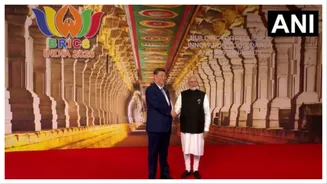






New Delhi: Prime Minister Narendra Modi’s welcome for BRICS leaders at Bharat Mandapam on Saturday had a distinctly Indian touch with the iconic Ramanathaswamy
Temple of Rameswaram, Tamil Nadu, forming the backdrop for the official interactions.
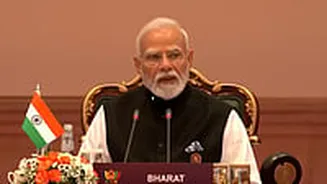
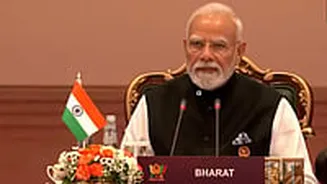
Among those welcomed by Modi was Chinese President Xi Jinping who is in India for the 18th BRICS Summit and is marking his first visit to India after seven years. During their interaction, Modi was seen explaining the cultural and architectural significance of the historic Shiva temple to Xi. The same backdrop was also used as other visiting leaders arrived at the summit venue.
Modi welcomed Brazilian Foreign Affairs Minister Mauro Vieira, Ethiopian Prime Minister Abiy Ahmed Ali, Iranian President Masoud Pezeshkian, Crown Prince of Abu Dhabi Sheikh Khaled bin Mohamed bin Zayed Al Nahyan and Indonesian President Prabowo Subianto. The Prime Minister was accompanied by the External Affairs Minister S Jaishankar during the welcome.
The choice of the Ramanathaswamy Temple carries significance beyond its architecture. Located on Rameswaram island, the ancient temple is dedicated to Lord Shiva and is counted among the 12 Jyotirlingas. It is also one of the four Char Dham pilgrimage sites, giving it a special place in Hindu religious tradition.
During the welcome of BRICS leaders, Prime Minister Narendra Modi welcomed the leaders against the backdrop of the iconic Ramanathaswamy Temple in Rameswaram, Tamil Nadu. pic.twitter.com/J9SFU8WeJV
— ANI (@ANI) September 12, 2026
Why Ramanathaswamy Temple holds such importance
Rameswaram is closely linked with the Ramayana and has long been associated with Lord Rama’s worship of Lord Shiva. According to local belief, Rama worshipped Shiva at this site before setting out towards Lanka.
The temple is also known for its 22 tirthas or sacred water sources where devotees traditionally take ritual baths. Rameswaram and Varanasi are considered particularly important pilgrimage destinations with devotees believing that visiting both places holds deep spiritual significance.
The temple’s architecture is another reason it stands out with its long corridors, carved pillars and imposing gopurams have made it one of Tamil Nadu’s best-known heritage landmarks.
Temple’s remarkable architecture
The construction of the present temple complex took place over several centuries under different rulers with work beginning from around the 12th century. The Sethupathi rulers played an important role in developing the structure including its famous corridors.
The temple’s third corridor is particularly notable for its enormous scale. It stretches about 197 metres from east to west and 133 metres from north to south and is widely recognised as one of the longest temple corridors in the world. The shrine has also attracted prominent visitors over the years. Swami Vivekananda is believed to have visited and worshipped at the temple in 1897.
By placing the Ramanathaswamy Temple at the centre of the BRICS welcome setting, India brought its religious, cultural and architectural heritage into an event attended by leaders from some of the world’s major emerging economies.