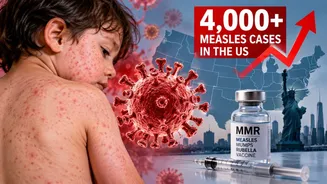










New Delhi: The US has now reported more than 4,000 cases of measles in 2026, a troubling resurgence of a disease the nation declared eliminated more than two
decades ago. The rise has raised fresh alarm among health officials, particularly as most of the infections have been in people who are unvaccinated or whose vaccination status is unknown. Updated data from the US Centres for Disease Control and Prevention (CDC) shows that 4,080 cases of measles have been confirmed this year. Cases have been reported across 45 states and Washington, DC, while 18 infections involved international visitors to the country.
Children and teenagers have accounted for the majority of infections. CDC data also show that about one in 10 infected children younger than five have required hospitalisation. The surge has already prompted New York Governor Kathy Hochul to declare a state disaster emergency as authorities try to control the spread and make vaccination and testing more accessible.
Why are US measles cases rising?
One of the clearest patterns in the outbreak is the vaccination status of those becoming infected. According to the CDC, around 95 per cent of reported measles cases have occurred among people who were unvaccinated or whose vaccination status was unknown. Around 2 per cent were among people who had received one dose of the measles, mumps and rubella (MMR) vaccine, while another 2 per cent involved those who had received two doses.
The rise comes at a time when childhood MMR vaccination coverage has been falling. During the 2025-26 school year, around 92.4 per cent of US kindergartners had received the MMR vaccine. Before the COVID-19 pandemic, coverage stood at 95.2 per cent during the 2019-20 school year.
That difference is important because measles spreads extremely easily. According to health authorities, as many as 90 per cent of susceptible people who come into close contact with an infected person can become infected. The World Health Organisation (WHO) considers population immunity of around 95 per cent important for preventing sustained measles transmission and protecting people who cannot be vaccinated.
42 measles outbreaks reported in 2026
The infections have not been distributed evenly across the US. Some areas have reported few or no cases, while others are dealing with sizeable clusters. The CDC defines a measles outbreak as three or more related cases. So far in 2026, 42 outbreaks have been recorded, accounting for around 95 per cent of reported infections.
Pennsylvania has been among the hardest-hit states. Health officials there have reported more than 1,000 cases this year across dozens of counties. The state has also reported five measles-associated deaths in 2026. The CDC’s national count currently recognises fewer deaths, although the agency notes that its figure is subject to change as information is reviewed and updated.
New York declares emergency over measles
Concerns over the growing outbreak prompted New York Governor Kathy Hochul to declare a State Disaster Emergency on October 5. The order is expected to remain in effect until November 4, 2026, and is designed to expand the state’s ability to respond to the outbreak.
“No one should get seriously ill or die from a vaccine-preventable disease,” Hochul said in a statement. “That is why I have taken steps to increase the number of health professionals who can vaccinate and test. These emergency measures will protect New Yorkers and support our community partners as they work tirelessly to address the spread of this disease,” he added.
More than 100 measles cases have been confirmed in New York this year, with a sharp rise recorded in recent months. New York State Health Commissioner James McDonald has urged residents to check their vaccination records and ensure that they and their families are adequately protected.
What are the symptoms of measles?
Measles is a highly contagious viral infection that spreads through the air and respiratory secretions when an infected person coughs or sneezes. Symptoms do not necessarily begin with the rash for which the illness is widely recognised.
People may initially develop a high fever, cough, runny nose and red or watery eyes. The rash that is typical usually appears later, beginning on the face and spreading to the neck and then to the rest of the body. Some people get over it with no serious complications. But measles can be dangerous, especially for young children, pregnant women and people whose immune systems are weak.
Complications may include pneumonia and inflammation of the brain. Infection during pregnancy can also be a risk for the pregnant woman and the pregnancy. A rare but serious neurological complication known as subacute sclerosing panencephalitis (SSPE) can occur years later after measles and causes progressive brain damage.
Is MMR vaccine effective?
CDC recommends children get 2 doses of the MMR vaccine. The first is usually given between 12 and 15 months of age and the second between 4 and 6 years of age.
One dose is about 93 per cent effective at preventing measles, and two doses are about 97 per cent effective, the CDC says.