







London: A marble slab removed from the Taj Mahal more than two centuries ago during British rule in India is set to be auctioned in London on December
9. The intricately decorated slab, which remained in the same British family for over 200 years, is expected to fetch between £20,000 and £30,000 (approximately Rs 24 lakh to Rs 36 lakh).
The artefact was taken by Colonel Pownoll Phipps (1780-1858), a senior East India Company officer who served as the superintendent of historic buildings in Agra. His responsibilities included overseeing repairs and maintenance work at the Taj Mahal and other historical monuments.
Taj Mahal marble slab auction
View this post on Instagram
According to accounts recorded in his son’s memoirs, Phipps discovered the marble panel inside an underground chamber beneath the Taj Mahal, TOI reported. He believed it had been placed there for use in restoration work and was subsequently allowed to keep it.
The slab was among two marble panels that Phipps collected from the monument in 1816, towards the end of his tenure in Agra.
During his time in the city, he was also once called to the Taj Mahal to stop an Englishwoman from removing agates from the monument’s marble using a steel fork.
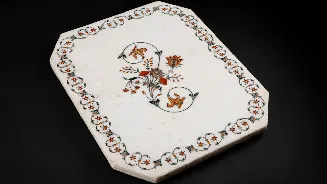
The rectangular marble piece measures 55.8 cm in length, 45.2 cm in width and 3 cm in thickness. Its corners are chamfered, while its surface features detailed floral designs made using polished and flattened semi-precious stones.
The decorative work includes agate, jasper, chalcedony and other stones. Experts have noted similarities between its floral border and the decoration along the upper surface of the cenotaph of Mughal emperor Shah Jahan inside the Taj Mahal.
The floral scroll on the slab also resembles a design found on the left-hand side of the cenotaph’s upper surface.
Taj Mahal marble slab auction on December 9
Auction house Lyon & Turnbull will offer the artefact in London and online as part of its Islamic and Indian Art sale.
Kristina Sanne, head of the auction house’s Islamic and Indian Art department, said the item’s documented history and connection to the monument made it particularly significant.
“It is a privilege to offer a piece with such a comprehensive history and that is linked to one of the most famous buildings in the world. The fact that it has turned up 210 years after being brought home by a senior British functionary, and still in his family, is quite extraordinary,” she said.
The auction will bring renewed attention to an artefact that has remained outside India for more than two centuries.