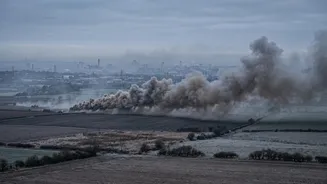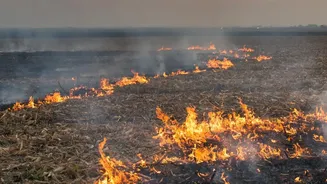








A sharp rise in crop-residue fires in Pakistan’s Punjab province could add to the air pollution burden in northern India, with north-westerly winds expected
to carry smoke and pollutants across the border. The development comes as stubble-burning incidents are also increasing in India’s Punjab, raising concerns over air quality in Delhi-NCR and neighbouring states.
The India Meteorological Department (IMD) has forecast north-westerly winds for the next four days. With no western disturbance expected for at least a week, weather conditions could remain unfavourable for the dispersal of pollutants, potentially worsening air quality across the region.
Pakistan Punjab records more farm fires than Indian Punjab
Satellite data showed that Pakistan’s Punjab recorded more than four times the number of crop-fire detections reported in Indian Punjab during the first 29 days of October.
According to a report by Pakistan’s Dawn, which cited data analysed by environmental monitoring platform HamariHawa, NASA’s Fire Information for Resource Management System (FIRMS) detected 13,241 fire spots in Pakistan’s Punjab. The corresponding figure for Indian Punjab was 3,158. However, official data from India’s Pollution Control Board recorded 1,007 stubble-burning incidents during the same period.
In Indian Punjab, Tarn Taran reported the highest number of farm fires at 397, followed by Amritsar with 171 and Ferozepur with 104. Sangrur, Patiala, Gurdaspur, Kapurthala and Bathinda were among the other affected districts.
NASA data indicated that 92% of the detected fire spots in Pakistan’s Punjab were on farmland and were likely linked to crop burning.
According to India’s Commission for Air Quality Management (CAQM), Punjab reported 1,612 farm fire incidents up to November 2.
The situation intensified in the final week of October, when 6,655 fire spots were detected in Pakistan’s Punjab. This accounted for around half of the detections recorded during the 29-day period. October 29 saw the highest daily count, with 1,327 fire spots.
Okara emerged as the biggest hotspot, recording 2,144 detections between October 1 and 29. Gujranwala and Nankana Sahib reported 1,011 and 1,003 respectively. Together, the three districts accounted for 4,158 fire spots, exceeding the total recorded in Indian Punjab.
Delhi AQI remains severe
The rising number of farm fires could add to pollution levels in Delhi-NCR. On Tuesday morning, Delhi’s overall AQI stood at 331, placing it in the very poor category, according to the Central Pollution Control Board (CPCB).
Several monitoring stations recorded severe air quality, with Jahangirpuri at 451, Rohini at 431, Punjabi Bagh at 424, Vivek Vihar at 411, DTU at 409 and Narela at 408. Noida’s Sector 62 also recorded a severe AQI of 406.