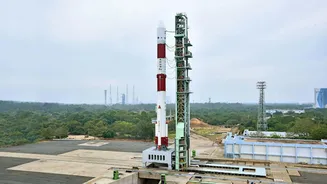

New Delhi: During ISRO’s PSLV-C62 flight today, the rocket lifted off successfully from the first launchpad in Sriharikota in favourable weather conditions.
The first two stages of the rocket performed nominally, with the heat shield successfully separating 167 seconds into the flight at an altitude of 116 km. The third stage entered into a planned coast stage, after which the rocket began to tumble uncontrollably, leading to the loss of the mission. ISRO Chairman V Narayanan said, “Close to the end of the third stage, we were seeing little more disturbance in the vehicle roll rates, and subsequently there is a deviation episode in the flight path. We are analysing the data and we shall come back at the earliest.”
All previous failures of Indian rockets were carrying domestic payloads. In fact, the first foreign satellites ever launched by ISRO were on the PSLV-C2 flight on 26 May 1999, that carried a payload each for Germany and Korea. The Polar Satellite Launch Vehicle (PSLV) is among the most reliable launch vehicles in the world, and has deployed over 345 foreign satellites from 36 different countries. Cell tower interference at the ISTRAC facility in Bengaluru prevented US-based Astroforge from recovering the tumbling Odin asteroid mining mission in March last year, which was launched by a SpaceX Falcon 9, and not ISRO.
Foreign satellites on PSLV-C62 flight
There were eight foreign payloads on the PSLV-C62 flight. These were the Theos-2 Earth Observation Satellite jointly built by UK and Thailand, the Munal technology demonstration satellite from Nepal, and five satellites by AlltoSpace in Brazil, that focuses on academic satellites and capacity building. These satellites were Edusat, Uaisat, Galaxy Explorer, Aldebaran-1 and the Orbital Temple, a collaborative artwork project that anyone could have participated in. There was also the Kestrel Initial Demonstrator cargo capsule by the Spanish new Space Startup Orbital Paradigm. The reentry capsule was itself carrying payloads from UK, Germany and France. A transparent enquiry is the need of the hour, where ISRO finds the root cause, and permanently fixes the issue.