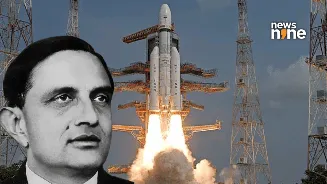

New Delhi: Every year on 30 December, India pauses for a moment to remember Vikram Sarabhai, the man who quietly changed the country’s destiny in space
and science. It has been decades since his passing, but his work refuses to fade. As a journalist, and honestly as an Indian who grew up hearing “ISRO” like a magic word, I still feel his story is more human than textbook. A young scientist with big ideas, lots of courage, and a very calm smile managed to build something that touches every Indian life today, whether we realise it or not.
He is called the father of India’s space programme, but that title never really captures the range of what he actually did. He founded institutions, built labs, inspired generations, convinced governments, and shaped dreams at a time when India was still finding its feet as a nation.
पद्म विभूषण से अलंकृत, इसरो के संस्थापक एवं महान वैज्ञानिक डॉ. विक्रम साराभाई जी की पुण्यतिथि पर उन्हें विनम्र श्रद्धांजलि!
भारतीय अंतरिक्ष कार्यक्रम को सशक्त दिशा देने, विज्ञान को जनकल्याण से जोड़ने और राष्ट्र को वैज्ञानिक आत्मनिर्भरता की ओर अग्रसर करने में उनका दूरदर्शी योगदान… pic.twitter.com/zlOOJrO5RF
— Keshav Prasad Maurya (@kpmaurya1) December 30, 2025
The scientist who built India’s space vision
Vikram Ambalal Sarabhai was born on 12 August 1919 in Ahmedabad to a Jain industrialist family. He was brilliant early. He studied natural sciences at St. John’s College, Cambridge, returned to India during World War II, and worked at the Indian Institute of Science in Bengaluru under Nobel laureate C.V. Raman. His research on cosmic rays later earned him a PhD from Cambridge.
He did not stop at research. He built the Physical Research Laboratory in 1947, which is still called the cradle of India’s space science. He helped start the Indian Institute of Management, Ahmedabad, founded the Community Science Centre, and co-founded Darpan Academy of Performing Arts with his wife Mrinalini. His vision later led to the Vikram Sarabhai Space Centre, Space Applications Centre, ECIL, and UCIL.
Remembering Dr. Vikram A. Sarabhai!
On his death anniversary, we remember #VikramASarabhai, the Father of India’s Space Program and the visionary, who dreamed of #space not for #prestige, but for #people.
He taught us that #science must serve #society – uplifting lives,… pic.twitter.com/GfajV6sOEM
— Narottam Sahoo (@narottamsahoo) December 30, 2025
Building ISRO and taking India to space
Sarabhai founded ISRO with a belief that space technology must serve society. He pushed for satellites to support education and development. His work with NASA led to the Satellite Instructional Television Experiment (SITE), which helped bring educational content to villages and laid early foundations for broadcast in India. He also initiated work on Aryabhata, India’s first satellite launched in 1975.
Homi Bhabha supported him in setting up the first rocket launch station in Thumba. After Bhabha’s death, Sarabhai took charge of the Atomic Energy Commission. Many younger scientists, including A.P.J. Abdul Kalam, saw him as mentor and guide.
A legacy that refuses to fade
He received the Padma Bhushan in 1966 and the Padma Vibhushan posthumously. A lunar crater is named “Sarabhai Crater.” The Vikram Sarabhai Space Centre carries his name proudly. He died in his sleep in 1971 at the age of 52, leaving behind work that India is still building on.
Even today, when India lands near the Moon’s south pole or sends spacecraft to Mars, you can almost hear a quiet echo of the man who once said India deserved to be there.