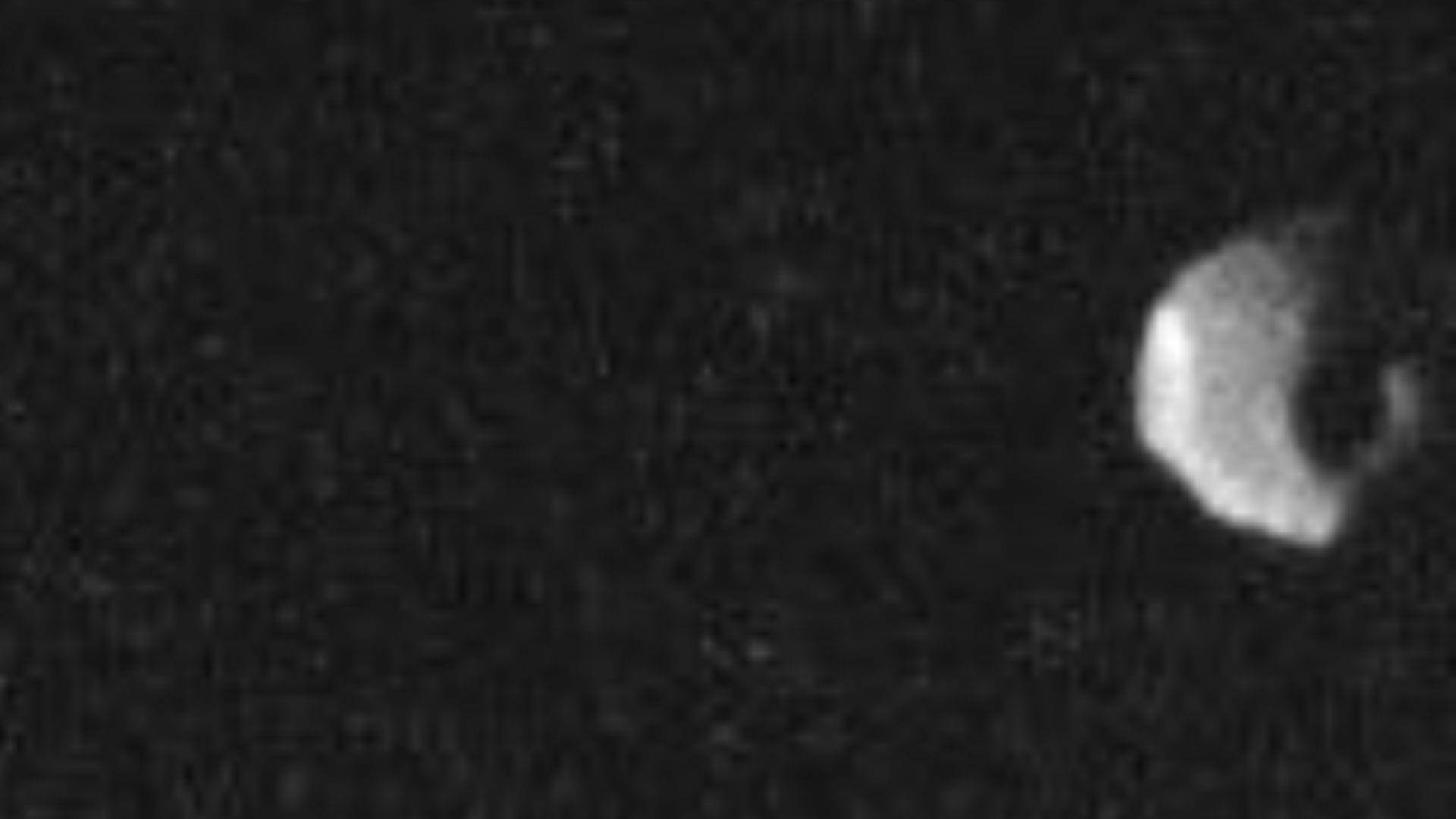








New Delhi: NASA’s Juno spacecraft captured a view of the second largest of Jupiter’s inner moons, Thebe, during a close pass on 1 May, 2026. The Stellar
Reference Unit (SRU) on the spacecraft captured the image from a distance of about 5,000 kilometres, at a resolution of about three kilometres per pixel. The instrument is primarily used to image stars for navigation, but its sensitivity in low-light conditions makes it a powerful secondary science instrument. Thebe resides in the fringes of the outer edge of Jupiter’s faint ring system, and is believed to play a role in the formation of the gossamer ring by shedding dust.
The Juno mission is the most distant operating planetary orbiter, and was threatened by funding cuts by the Trump administration, but was saved by the US Congress. Thebe was discovered in 1979 in imagery captured by the Voyager 1 spacecraft. The moon has an irregular shape, with a mean radius of about 50 kilometres. It has a dark reddish surface, and is heavily cratered, and is also dark. The largest named feature on Thebe is a 40 kilometre wide crater named Zethus. Thebe is tidally locked to Jupiter just like the Moon of Earth is tidally locked to the Earth.
Thebe likely formed around Jupiter
Thebe is the fourth-closest moon to Jupiter and belongs to the regular prograde inner satellite group. Prograde satellites orbit their host world in the same direction as the rotation of the planet. The exact origins of Thebe is uncertain, but evidence indicates to it forming within the circumplanetary disk of Jupiter, and that it is not a captured asteroid. Spectra data suggests that it formed in the cooler outer regions of the circumplanetary disk before navigating inwards into its current orbit, through resonances with larger moons such as Io. Thebe has a low density, and is likely to be composed of a mixture of Rock and Ice.