








New Delhi: A sharp exchange at Davos has put India’s position in the global AI race back into focus. What started as a broader discussion on how artificial
intelligence is spreading across economies quickly turned into a clear pushback from New Delhi, with India rejecting any suggestion that it sits outside the top tier of AI nations.
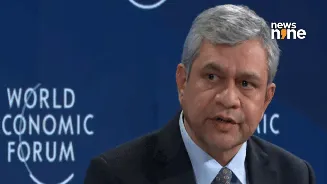
On the sidelines of the World Economic Forum in Davos, Union Minister for Electronics and IT Ashwini Vaishnaw responded strongly to remarks made earlier by IMF chief Kristalina Georgieva. The moment stood out, not for theatrics, but for how directly India challenged an international classification on a global stage.
India rejects IMF grouping at Davos
Speaking during a high level discussion at the World Economic Forum, Ashwini Vaishnaw said India belongs to the “first group” of AI powers. His response came after International Monetary Fund Managing Director Kristalina Georgieva spoke about emerging economies showing strength in AI adoption.
“Actually, clearly in the first group,” Vaishnaw said, rejecting the idea that India sits in a secondary category.
Georgieva had earlier said, “Actually, India would be one of them because of the bet on IT that India is making that is in the higher spectrum,” while adding that many countries were “way, way behind.”
Five layers of India’s AI push
Vaishnaw explained India’s position by pointing to work across the full AI stack. “There are five layers in the AI architecture, the application layer, the model layer, the chip layer, the infra layer and the energy layer,” he said. “We are working on all five layers, making very good progress in all five layers.”
From chips to energy, the claim was simple. India is not betting on just one piece of the puzzle.
Stanford rankings enter the debate
The minister also questioned the IMF’s criteria directly. “I don’t know what the IMF criteria has been,” he said, before citing Stanford. According to Vaishnaw, Stanford places India third globally on AI penetration and preparedness, and second on AI talent.
“So I don’t think your classification in the second bouquet is right. It’s actually in the first,” he said.
Why applications matter more than size
Vaishnaw stressed that returns come from real use. “On the application layer, we will probably be the biggest supplier of services to the world,” he said. He added that “ROI doesn’t come from creating a very large model,” arguing most use cases work with 20 to 50 billion parameter models.
As India prepares to host an AI summit next month, the message from Davos was clear. India wants to shape the AI story on its own terms, not as a footnote, and not as a follower.