






Scientists have discovered what could be the oldest convincing evidence of dinosaur red blood cells, preserved inside bones dating back 115 million years.
The discovery has immediately raised a question that would make any Jurassic Park fan excited. Could we finally bring dinosaurs back to life? Well, the answer is still no, but the discovery could change how scientists study animals that disappeared millions of years ago.
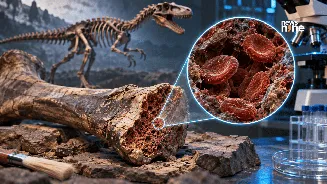
The findings, published in the journal Proceedings of the National Academy of Sciences on November 2, 2026, come from an international research team led by Australia’s Curtin University. Researchers examined leg bones belonging to Aratasaurus museunacionali, a meat-eating dinosaur that lived in what is now Brazil during the Early Cretaceous period.
What exactly did scientists find inside the dinosaur bones?
The dinosaur was approximately 3.1 metres long and weighed around 34 kilograms. Its fossils were recovered from a Brazilian mine in 2008.
Using microscopes and chemical testing, researchers found tiny oval structures inside channels that once carried blood vessels.
More importantly, they detected chemical traces of heme, an iron-containing molecule associated with haemoglobin, which helps red blood cells carry oxygen.
Lead researcher Professor Kliti Grice said, “To detect intact heme derived molecules in 115-million-year-old red blood cells is astonishing: this really is a landmark discovery.”
Researchers believe minerals and low-oxygen conditions helped preserve these microscopic structures.
Read more: November 2026 night sky guide: Two meteor showers, a supermoon and rare planetary encounters to watch in India
Can we now clone dinosaurs like Jurassic Park?
Unfortunately for dinosaur fans, we are nowhere near opening a real Jurassic Park.
The researchers found mineralised structures and chemical remains, which are very different from living blood cells.
Cloning a dinosaur would require genetic information that scientists could use to reconstruct its genome.
The team tested the fossils for ancient DNA and found none.
That means:
- Scientists cannot extract usable dinosaur DNA from this discovery.
- The fossil does not contain living blood cells.
- The findings could help researchers understand dinosaur biology and how ancient tissues survive fossilisation.
Are scientists completely convinced?
There is still some scientific debate.
Palaeontologist Mary Schweitzer, who was not involved in the study, questioned whether the microscopic structures truly represent dinosaur red blood cells. Their appearance differs from what scientists expect in birds and reptiles.
She nevertheless found the chemical evidence interesting.
The discovery could encourage scientists to re-examine thousands of dinosaur fossils already stored in museums.
For now, the closest we are getting to Jurassic Park remains the cinema screen. The science, though, has taken an interesting step forward.