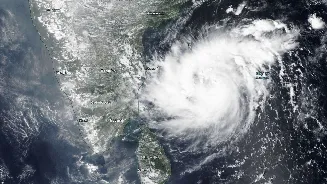









As Cyclone Akvan over the Bay of Bengal intensifies and moves towards the Andhra Pradesh coast, the name of the cyclone has drawn attention. The name was
proposed by Iran as part of the regional cyclone naming system. But what does Akvan mean, and why did Iran name a cyclone in the Bay of Bengal?
Cyclone Akvan meaning
Akvan has its roots in Persian folklore and is associated with Akvan Div, a mythical demon-like character from the Shahnameh, one of the most celebrated works of Persian literature.
The Shahnameh, also known as the Book of Kings, is a major Persian epic written by poet Ferdowsi. It features stories of kings, warriors and mythical beings.
Akvan Div is portrayed as a powerful and cunning adversary in these traditional tales. The name is therefore linked to a character from Iran’s cultural and literary heritage.
There are also references to Aka Manah in Zoroastrian texts, where the term translates to ‘Evil Mind’, ‘Evil Purpose’ or ‘Evil Thinking’. However, the official cyclone naming list does not provide a specific translation or explanation for the name Akvan.
Why did Iran name Cyclone Akvan?
Cyclone names are not selected randomly when a storm develops. They come from a predetermined list prepared by a regional panel comprising 13 countries, including India, Iran, Bangladesh and Pakistan.
The panel operates under the World Meteorological Organisation (WMO) and the United Nations Economic and Social Commission for Asia and the Pacific (UNESCAP). In 2020, the member countries compiled a list containing 169 names.
Each country contributes names to the list, which are then used in a fixed sequence. The Regional Specialised Meteorological Centre (RSMC) in New Delhi assigns the next available name when a cyclonic storm develops over the North Indian Ocean.
This means Iran’s contribution can be used for a cyclone developing over the Bay of Bengal or the Arabian Sea, regardless of whether the storm affects Iran.
When will Cyclone Akvan make landfall?
According to the India Meteorological Department (IMD), Akvan is likely to intensify into a very severe cyclonic storm by the morning of November 19.
The weather department has forecast that it could cross the Andhra Pradesh and Yanam coasts between Nellore and Tuni around noon on November 20.
Cyclone naming helps authorities, emergency services and the public identify weather systems easily, particularly when multiple storms are being monitored at the same time.