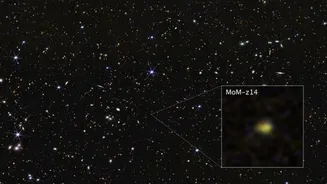







New Delhi: The James Webb Space Telescope (JWST) has confirmed the most distant galaxy yet, MoM-z14 that formed within 280 million years of the Big Bang.
This pushes observations closer to the cosmic dawn, when the first stars began to shine, and reveals an early universe that defies conventional theories. Astronomers have measured a redshift of 14.44 in the object, indicating that the light from the distant object travelled for about 13.5 billion years through an expanding spacetime. This confirmation relied on spectroscopy to verify estimates from the imagery, ensuring the accuracy of the distance measured. The discovery highlights how Webb sees farther than any other astronomical instrument.
Because of the expansion of the universe driven by dark energy, the physical distances and timelines at such extreme scales remain complex. MoM-z14 joins a group of unexpectedly bright galaxies from the dawn of time, around 100 times brighter than predictions from before Webb was launched. MoM-z14 shows some unusual features, including nitrogen levels too high for its age. There was insufficient time for generations of stars to produce such enrichment, with the elements forged in the nuclear furnaces at the hearts of stars, through a process called nucleosynthesis. Scientists suspect that the early dense universe formed supermassive stars capable of producing more nitrogen than those seen in the local or recent universe.
The legacy of discovery continues
Observations of MoM-z14 also suggest that the galaxy played a role in clearing the primordial hydrogen fog during a period in the early universe known as reionisation, where the universe was rendered transparent by the light from the first stars that broke through the dense hydrogen gas, known as the Cosmic Dawn. Webb was purpose-built to map the timeline of this era, which was previously shrouded. Webb has uncovered a number of luminous early galaxies. The Nancy Grace Roman Telescope is expected to expand this sample to thousands, through a combination of high-resolution imaging with wide fields.