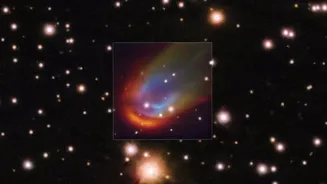







New Delhi: Astronomers have used the Very Large Telescope operated by the European Southern Observatory to capture a shock wave around a dead star. The
discovery has puzzled astronomers as the shock waves is being produced by an unknown process. The white dwarf is designated as RXJ0528+2838, has a companion similar to the Sun, and is located at 730 lightyears away. The scientists did not expect to see such shock waves being formed by a dead star. Like the Sun and other stars, the star rotates around the core of the galaxy. As it moves, it is interacting with interstellar gas, creating a type of shock wave called a bow shock.
The bow shock is so named for its similarity to the wave that builds up in front of a ship. These bow shocks are usually created by material flowing out of the central star, but RXJ0528+2838 has violently shed its outer layers after running out of helium to fuse into hydrogen. No known mechanism can fully explain the observations, but the astronomers suspect that magnetic fields may play a role. The strange nebulosity around RXJ0528+2838 was first spotted on images captured by the Isaac Newton Telescope in Spain, with VLT used to conduct detailed, follow-on observations.
Magnetic fields may cause the bow shock
The shape and size of the bow shock indicate that the white dwarf has been expelling a powerful outflow for at least 1000 years. Scientists do not know exactly how a dead star without an accretion disk can power such a long-lasting outflow. The white dwarf is known to host a strong magnetic field. This field channels material siphoned off from the binary companion directly onto the white dwarf, without forming an accretion disk. The researchers intend to further investigate the mystery engine that is driving the bow shock, by studying RXJ0528+2838 further, as well as other binary systems.