









New Delhi: NASA’s Perseverance rover has completed the first drives on another planet planned entirely by artificial intelligence on 8 and 10 December,
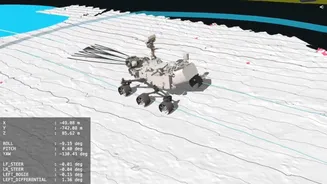
2025. The drives occurred around the rim of the Jezero Crater, covering about 400 metres of rocky terrain. Engineers at NASA’s Jet Propulsion Laboratory collaborated with Anthropic, to use the company’s Claude vision-language model for achieving the feat. The AI analysed orbital imagery from the HiRISE camera on the Mars Reconnaissance Orbiter (MRO), along with terrain elevation data to identify hazards such as boulders, outcrops of bedrock and sand ripples carved by ancient flowing surface water. The AI generated a sequence of waypoints spaced about 10 metres apart, forming a safe, continuous path. Human rover planners traditionally perform this task manually because of the 20-minute communication delay between Earth and Mars, which prevents realtime control.
The AI produced commands in the Rover Markup Language, an XML-based format used to command Mars rovers. Claude iterated on its plans by self-critiquing and refining waypoints. JPL engineers simulated the routes using over 500,000 variables in the validation software used by Perseverance to predict hazards and rover positions. Minor adjustments were made after the reviews, primarily to account for sand ripples visible only in ground-level images that the AI had not processed. The rover executed both the drives successfully, and followed the AI-generated paths with high accuracy. The demonstration integrated generative AI into operations at JPL’s Rover Operations Centre.
Implications for future exploration
The successful AI-planned drives reduce route-planning time by an estimated 50 per cent, allowing for more frequent excursions, increased data collection, and ultimately, a higher science return from the mission. Human oversight remains essential for validation, but the approach enables more consistent and efficient operations. As missions extend farther from Earth, with signal delays reaching hours or days, autonomous AI systems are expected to support probes exploring distant targets, such as Europa or Titan. The capability also applies to NASA’s Artemis programme for lunar surface operations, where efficient resource use is critical for establishing a sustained presence on the Moon.