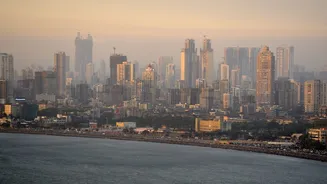









New Delhi: A recent global cost of living rankings 2025–26 have ranked Zurich and Geneva as the most expensive places to live in the world. It has placed
Mumbai — considered the most expensive city in India — at the 445th spot. Gurgaon (450), Delhi (454), Pune (455), Bengaluru (457), and Noida (458) are closely behind Mumbai.
The rankings go to show that even India’s costliest cities rank much lower globally. The data also indicates that even India’s most costliest cities continue to be among the more affordable places to live globally, even at their maximum cost levels.
Which Indian cities are ranked costliest
India’s most expensive cities are way down the global rankings. Mumbai leads the rankings. It is placed at 445th position globally. Gurgaon is at the 450th spot, Delhi 454th, Pune 455th, Bengaluru 457th, Noida 458th, Hyderabad 459th, Ahmedabad 461th, Chandigarh 463rd, Chennai 465th, Vadodara 468th, Bhubaneswar 470th, Patna 471th, Bhopal 472nd, Kolkata 473th, Kochi 474th, Jaipur 475th, Surat 476th and Indore 477th.
Even at their highest cost, Indian cities still fall outside the world’s top 400 costliest places to live.
India’s cost of living index is around 18–19, which means it is among the lowest in the world. Even in its most expensive cities, expenses like rent, food, and transport are far lower than in other major metros across the world.
Which are world’s most expensive cities
At the top of the chart is Zurich, whose Cost of Living Index is 122.8. It is followed by Geneva, Basel, Lausanne, Bern, Lugano, New York, Reykjavik, Honolulu and San Francisco. Interestingly, the six costliest cities are all located in Switzerland.
Top global cities have the highest living costs, and this driven by stronger currencies, higher wages, and expensive services.
How were the rankings done
The baseline is New York City. The ranking is fixed at a benchmark value of 100 on the cost of living index. Cities that score above 100 are more expensive, while those below 100 are cheaper.
The rankings were made after a rigorous, multi-step process that analyzes the cost of maintaining a certain lifestyle across different locations. The rankings weighed the cost of over 200 items, including groceries, dining out, utilities, transport, and housing. The data was collected from regular retail price surveys, user-submitted inputs (such as Numbeo), and government statistics. The main factors considered housing and rent, currency fluctuations, import dependence and lifestyle indicators, including premium services (e.g., private schooling, international cuisine).