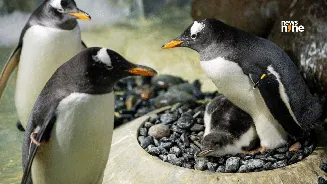










Scientists have identified a new species of penguin for the first time in more than 100 years. The bird, named Pygoscelis kerguelensis, lives on the remote
Kerguelen Islands in the southern Indian Ocean. The discovery is particularly interesting since these penguins have been living there for thousands of years, largely unnoticed by science.
An international team led by researchers from Chile and the University of California, Berkeley, made the discovery using genetic analysis. Their findings, published in the journal Communications Biology in April 2026, suggest that gentoo penguins, previously treated as one species, actually belong to four distinct species. The discovery has gained renewed attention this September.
Where was the new penguin species discovered?
The newly identified bird is called the southeastern gentoo penguin.
It inhabits the Kerguelen Islands, a remote group of islands roughly 3,200 kilometres from the nearest permanently inhabited landmass.
The penguin looks remarkably similar to its relatives. It has a black back, white belly and orange beak. Scientists found subtle differences in its size and calls, but its DNA provided the clearest evidence of its separate identity.
To establish this, researchers analysed the complete genetic information of 64 penguins collected from 10 breeding colonies.
They compared their physical appearance, feeding habits and breeding behaviour.
The results revealed genetic differences significant enough for researchers to propose recognising four separate gentoo species.
How did scientists miss this penguin for so long?
The answer lies partly in geography.
Gentoo penguins live across isolated islands in the Southern Hemisphere. Their colonies can be separated by thousands of kilometres of ocean.
These birds generally remain close to their breeding colonies. Over hundreds of thousands of years, different populations developed genetic adaptations suited to their surroundings.
Researchers estimate that the four gentoo lineages separated approximately 300,000 to 500,000 years ago.
The study proposes recognising these four species:
- Northern gentoo penguin (Pygoscelis papua)
- Southern gentoo penguin (Pygoscelis ellsworthi)
- Eastern gentoo penguin (Pygoscelis taeniata)
- Southeastern gentoo penguin (Pygoscelis kerguelensis)
The southeastern gentoo is the newly described species. The other three were previously classified as subspecies.
Climate change could threaten the newly discovered species
The discovery comes with a warning.
Researchers predict that warming oceans could reduce suitable habitats for three of the four gentoo species by 2050.
The newly identified southeastern gentoo is among those facing potential habitat losses.
Juliana Vianna, a senior author of the study, told UC Berkeley that the gentoo penguin was of particular concern in the sub-Antarctic region.
“It’s very important that conservation institutions in all the different countries involved recognize and take appropriate action to save these three gentoo penguin species,” she said.
The study offers a clearer understanding of penguin diversity and could help conservationists develop protection plans for individual populations.