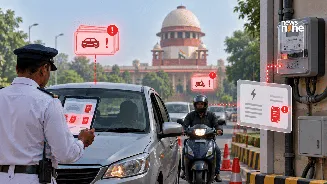









According to Bar and Bench, Justice JB Pardiwala raised concerns over the large amount of unpaid traffic fines across India. The court was informed that
states and Union Territories collectively have around ₹45,000 crore in e-challan dues, of which ₹25,000 crore has been recovered. The suggestions aim to address the gap between issuing traffic fines and collecting the money.
Could unpaid traffic challans affect your electricity bill?
The Supreme Court suggested that authorities examine the possibility of including pending traffic fines in electricity bills.
“If people are not paying traffic challans, add it to their electricity dues bill. They’ll have to pay electricity bills else power line will be disconnected. Work it out. In this country, you have to find a way out,” the court suggested, according to Bar and Bench.
The proposal would create an additional way to recover fines from vehicle owners who have ignored their challans.
The court’s remarks are suggestions at this stage. They do not establish a nationwide rule allowing electricity providers to disconnect connections over unpaid traffic fines.
Vehicle registration, driving licence and PUC could be affected
Justice Pardiwala suggested linking unpaid challans to several vehicle-related services.
According to Bar and Bench, the court proposed restricting registration certificate renewals, duplicate certificates and vehicle ownership transfers until outstanding fines are cleared.
The suggestions extend to fitness certificates, driving licence renewals and pollution under control (PUC) certificates.
The court said, “No centre should be permitted to issue PUC certificate.”
Authorities were also asked to consider blacklisting vehicles on the Parivahan portal and suspending existing driving licences in cases involving unpaid fines.
Can police seize vehicles over pending challans?
The Supreme Court suggested random vehicle checks to identify owners with outstanding e-challans.
If authorities find unpaid fines during these checks, they could consider impounding the vehicle, the court observed.
Explaining the problem, Justice Pardiwala said, “It is not just sufficient to keep issuing e-challans. Police may issue thousands and lakhs of such e-challans.”
The court stressed that collecting penalties was necessary for effective traffic enforcement.