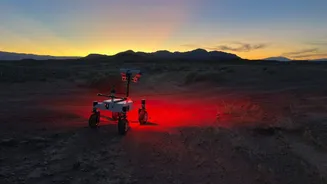









New Delhi: NASA engineers have successfully tested a new autonomous prototype rover in the Colorado Desert, advancing technology for future missions to the Moon
and Mars. The 1.2-metre-long vehicle, named Exploration Rover for Navigating Extreme Sloped Terrain (ERNEST), travelled 26 kilometres over 37 hours of driving, with minimal human intervention. Developed by the Jet Propulsion Laboratory, ERNEST demonstrated capabilities designed for long-distance, high-speed planetary exploration. The vehicle achieved speeds of up to one kilometre per hour, which exceeded the top navigation speed of current Mars rovers by an order of magnitude. This trial helped engineers refine mobility hardware and autonomy software for extreme distances and varied lighting conditions.
The success showed that such a vehicle could complete extended scientific road trips across the Moon or Mars, and proved the feasibility of scaling up the design to twice its current size. Previous Mars rovers used passive rocker-bogie suspension systems. The ERNEST design uses an active suspension system. Two powered joints operate a gimbal that allows the rover to alter its weight distribution, and use diverse gaits, including wheel-walking and obstacle-climbing. The rover lifted individual wheels over obstacles that would block older rovers, and switched to a passive suspension mode to conserve energy. Four steerable wheels also allow the vehicle to drive sideways, if necessary.
Meatspace test conducted after extensive simulations
Engineers began work on the project in 2022, to improve existing robotic mobility. The team built two smaller prototypes to test 11 suspension configurations in simulated lunar soil before constructing the full-scale model in September 2024. To enable independent decision-making, developers trained the algorithms of the rover using reinforcement learning inside a high-fidelity virtual environment. Computers simulated thousands of hours of terrain interactions, before the physical rover successfully navigated complex obstacle courses. A new phase of the project integrated active suspension control with long-range path planning.