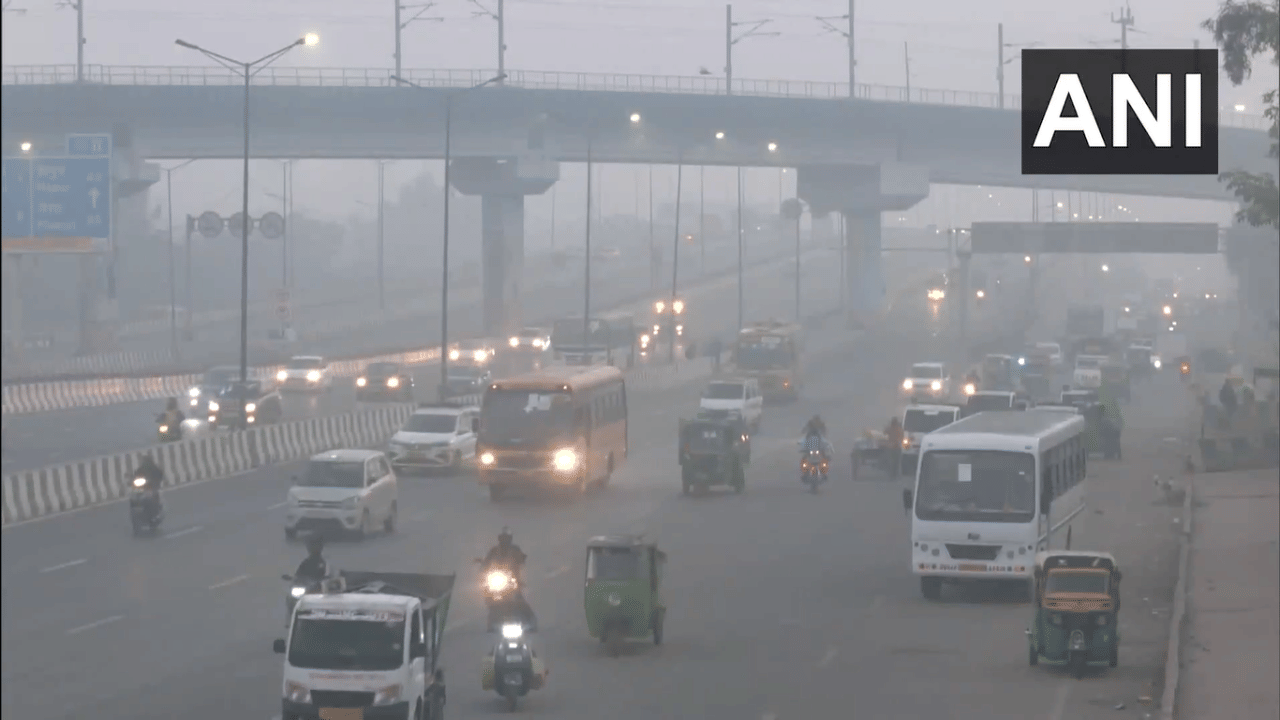

New Delhi: Delhi-NCR saw a slight improvement in air quality and visibility on Tuesday as north-westerly surface winds helped disperse the dense fog that
had blanketed the region on Monday. The improvement brought limited relief to residents after several days of choking pollution. However, authorities cautioned that disruptions to flight operations at the Delhi airport were likely to continue, even as conditions gradually recovered.
According to data from the Central Pollution Control Board’s (CPCB) Sameer app, Delhi’s air quality index (AQI) stood at 381 at around 6:30 am on Tuesday. This placed the city in the ‘very poor’ category, a noticeable decline from Monday’s average AQI of 427, which marked the third consecutive day of ‘severe’ pollution levels in the national capital.
Delhi AQI today
#WATCH | Delhi | Visuals from the ITO area as a layer of toxic smog blankets the city.
AQI (Air Quality Index) around the area is 401, categorised as ‘Severe’, as claimed by CPCB (Central Pollution Control Board).
CAQM (Commission for Air Quality Management) has… pic.twitter.com/n2kj2xzi8d
— ANI (@ANI) December 16, 2025
Despite the overall improvement, several areas continued to record dangerously high pollution levels. Wazirpur was the worst-affected locality, with an AQI reading of 434. Jahangirpuri followed closely with an AQI of 430. Monitoring stations at Mundka, Delhi Technical University (DTU) and Nehru Nagar also reported ‘severe’ air quality, with AQI levels ranging between 420 and 424.
On Monday, a thick haze had enveloped large parts of Delhi, sharply reducing visibility and making it difficult to see even a short distance ahead. The poor conditions significantly affected air traffic as hundreds of flights were impacted.
Fog Update issued at 0606 hours.
Kind attention to all flyers!#Fog #FogAlert #DelhiAirport pic.twitter.com/4sUm3mk8jX— Delhi Airport (@DelhiAirport) December 16, 2025
On Tuesday, both the Delhi airport and airlines issued advisories, warning passengers of possible delays and cancellations as visibility deteriorated.
Travel Advisory
As winter sets in, early mornings across Northern India can bring fog that may occasionally slow down flight movements. We wanted to share this gentle heads-up in advance, so you can plan with ease and check your flight status before heading to the airport…
— IndiGo (@IndiGo6E) December 15, 2025
SpiceJet tweeted, “Due to bad weather(poor visibility) in Ayodhya (AYJ), all departures/arrivals and their consequential flights may be affected. Passengers are requested to keep a check on their flight status .”
Meanwhile, dense fog has gripped Delhi and parts of north India, significantly reducing visibility and forcing trains to operate at slower speeds.
Several trains heading to Delhi from the eastern region are running hours behind schedule, with over 20 services affected so far. The Prayagraj Express is delayed by more than three hours, while the New Delhi–Varanasi Vande Bharat Express departed about 90 minutes late. The Rewa–Anand Vihar Terminal Superfast Express is running over four hours behind schedule. The Sangam Express, Shiv Ganga Express and the New Delhi Tejas Rajdhani Express have also been delayed by multiple hours due to foggy conditions.
While local pollution sources such as vehicular emissions, road dust and construction activity continue to be major contributors, experts say stubble burning is no longer a dominant factor this season. Research by the Centre for Science and Environment (CSE) noted that the crop-burning season is nearly over. Official data indicates that incidents of stubble burning in Punjab and Haryana have reduced substantially compared to previous years.
As per CPCB norms, an AQI between 0 and 50 is considered ‘good’, 51–100 ‘satisfactory’, 101–200 ‘moderate’, 201–300 ‘poor’, 301–400 ‘very poor’ and 401–500 ‘severe’.