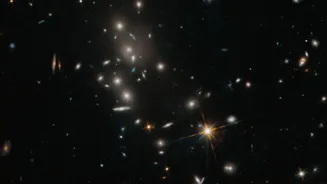









New Delhi: The Hubble Space Telescope has captured an image of the galaxy cluster designated as MACS J1141.6-1905, a galaxy cluster at a distance of around
four billion lightyears away in the southern constellation of Crater or the Cup. The image was captured as part of two Hubble observing programmes to investigate massive galaxy clusters that also shine brightly in X-rays. Both programmes are looking for distant galaxies gravitationally lensed by the foreground cluster, because of its high mass density. The scientists also want to better understand the interactions at the core of each cluster.
There are cross-shaped diffraction spikes that appear on a few stars. These are foreground stars in the Milky Way that are much closer to Hubble than the distant galaxy cluster. These diffraction spikes appear only on the most intense and concentrated sources of light. The diffraction spikes are caused by light bending around the internal support structure of the telescope, and can be considered as a signature of Hubble. The diffraction spikes on the James Webb Space Telescope appears as a six-pointed star because of the tripodal internal support structure and the hexagonal mirror segments.
The Hubble Archive
The visible and infrared observations of the bright X-ray clusters has been added to the Hubble archive. The Hubble archive of 1.7 million observations and counting is a valuable tool for current and future astronomers. There are two ways to conduct studies on Hubble, the first is to apply for and granted telescope time, that allows you to point the Hubble space telescope where you want and conduct the kind of observations that you require. The other is to just use the archival data of previously collected observations for your study. Such data is expected to drive new research based on Hubble observations for decades into the future,