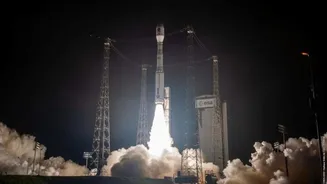







New Delhi: A joint European Space Agency (ESA) and Chinese Academy of Sciences (CAS) satellite has been launched into orbit from Europe’s spaceport in French
Guiana on board a Vega-C rocket, and is expected to be a major advancement in global space weather monitoring. The Solar Wind Magnetosphere Ionosphere Link Explorer (SMILE) mission will track how the constant stream of solar particles interacts with the magnetosphere of the Earth, providing data to protect communication, navigation and energy infrastructure, that are all impacted by severe space weather.
Previous spacecraft could only record single-point measurements as the crossed the boundary of Earth’s magnetic field. The SMILE mission allows scientists to image the boundary continuously. For the first time, researchers can observe how the geomagnetic field of the Earth, and the protective magnetic bubble changes shape, deforms or compresses in response to solar eruptions, shifting the science from theoretical modelling to direct observation. Understanding this interaction carries substantial economic significance. A 2022 risk assessment estimated that extreme solar storms could cause up to £9 billion damage to the UK economy by disabling GPS systems, disrupting shortwave radio communications and overloading electricity grids.
How the SMILE mission was realised
The SMILE mission was backed by £15 million in funding by the UK Space Agency. British institutions and aerospace firms led the development of the primary science payload. The Soft X-ray Imager (SXI) was built by a consortium led by the University of Leicester, and utilises innovative lobster-eye micropore optics to map out exactly where and how the solar wind influences the magnetosphere. Additional UK technologies includes an ultra-high-speed data wiring from Axon Cable, real-time control software developed by CGI, and advanced charge-coupled detectors from Teledyne e2v. A separate Ultraviolet Imager will capture continuous 45-hour recordings of global auroras, the first observations of the kind since 2005. Data from the mission will be integrated into the MET Office Space Weather Operations Centre, to improve realtime alerts.