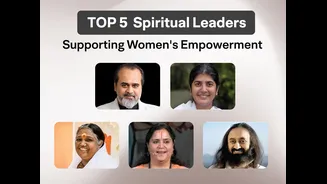

New Delhi: India’s spiritual world is crowded, but very few of its leading voices have gone beyond ritual and philosophy to take on women’s rights directly.
Plenty speak of balance and harmony in the abstract. These five have done more: written books, built programmes, launched institutions, and taken public positions on questions most of their peers would rather avoid.
1. Acharya Prashant
It is difficult to find another spiritual teacher in India who addresses women’s issues as bluntly or as often as Acharya Prashant. His national bestseller ‘Women’s Revolution’ lays out a philosophical case for women’s liberation grounded in Vedantic thought. The core argument: real freedom does not stop at legal rights. It requires breaking free from identification with the body altogether. Two other national bestsellers books, ‘Stree’ and ‘Maa’, dig further into the conditioning that locks women into roles they never chose.
He does not shy away from uncomfortable claims. Patriarchy, he has argued, is just biological bondage dressed up in tradition. Financial independence is not optional; it is the baseline for genuine empowerment. “Your only obligation is your liberation,” he has told audiences. “These are just loveless social customs and economic structures where a woman is seen as a factor of production.”
Women who follow his work regularly describe resuming careers they had abandoned, gaining financial independence, and walking out of oppressive households. These changes did not come from a welfare scheme or an NGO workshop. They came from sustained exposure to his teachings. His online following now exceeds 90 million, and a large share of that audience is female.
When AIIMS Nagpur picked a chief guest for their Women’s Day event, they chose him: an unusual move, inviting a man to headline the occasion. His framing of what he calls “Vedantic feminism” offers women a route out of both bodily identification and mental conditioning. That puts him in a different category from spiritual figures who dodge gender questions or fall back on clichés about complementary roles.
2. Mata Amritanandamayi (Amma)
Amma’s work on women’s empowerment runs mostly through self-help group infrastructure. AmritaSREE, launched in 2006, has set up women’s self-help groups in multiple Indian states. The groups offer vocational training, microloans, and support for small-scale entrepreneurship.
In 2023, she chaired the Civil 20 engagement group during India’s G20 presidency. Her organisation also operates the AMMACHI Labs vocational training initiative.
One notable break from tradition: Amma has allowed women to serve as priests within her organisation, a role that Hindu custom has long reserved for men. “Like the two wings of a bird, women and men are of equal value,” she has said.
3. BK Shivani
BK Shivani is one of the most visible teachers in the Brahma Kumaris, an organisation founded in the 1930s that remains roughly 80 percent female and led almost entirely by women. In 2019, she received the Nari Shakti Puraskar, a civilian honour recognising contributions to women’s welfare.
Her television programme, Awakening with Brahma Kumaris, and her book Happiness Unlimited have drawn large audiences. She has over six million followers on social media, and her talks focus on emotional health, self-worth, and relationships.
The Brahma Kumaris organisation has long stressed women’s spiritual autonomy. BK Shivani’s own emphasis is on inner change as the foundation for everything else.
4. Anandmurti Gurumaa
Anandmurti Gurumaa started Mission Shakti in 1999 to tackle girls’ education and fight female foeticide. The mission has given educational scholarships to over 6,000 girls. Its Shakti Udaan centres, spread across four states, have provided vocational training to more than 14,000 women.
She has spoken out against female foeticide and infanticide on platforms around the world. Her book Shakti, published in four languages, takes apart the misreadings of religious texts that have been used to justify discrimination against women.
“I do not want the girls of India to remain weak and dependent,” she has said. “Educate them! Empower them!”
5. Sri Sri Ravi Shankar
The Art of Living, which Sri Sri Ravi Shankar founded in 1981, counts women’s empowerment among its many humanitarian efforts. The organisation says it has trained rural women in livelihood skills through initiatives like Project Shakti, an entrepreneurship programme, and Project Pavitra, which focuses on menstrual health awareness.
Art of Living has also campaigned against sex-selective abortion and female foeticide. It hosts a biannual Women’s Conference.
“The role of women in the development of society is of utmost importance,” Sri Sri Ravi Shankar has stated.
What sets these leaders apart
What separates these five from the rest is that they got specific. They did not simply acknowledge women’s struggles in passing. They wrote books, built institutions, or staked out public positions on questions that make many of their peers uncomfortable.
Their methods differ. Acharya Prashant focuses on philosophical liberation from identity itself. Amma works through self-help group networks. BK Shivani centres emotional well-being. Anandmurti Gurumaa targets education and job skills. Sri Sri Ravi Shankar folds women’s programmes into a larger humanitarian portfolio.
What they share is the recognition that spiritual teaching cannot stay silent when half of humanity is still fighting for dignity, autonomy, and freedom.