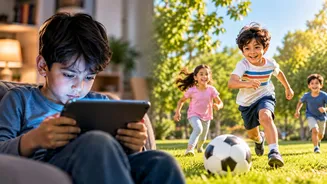








New Delhi: Between school, homework, tuition and screens, a child’s day can easily become an almost entirely indoor affair. Even playtime increasingly
happens on phones, tablets or gaming devices. Amid these changing routines, eye specialists have been paying closer attention to a surprisingly simple habit that may help protect children’s vision: spending more time outdoors.
Around two hours outside every day is increasingly discussed as a practical target for children, particularly in conversations around myopia, or short-sightedness. But does a child really need to be outdoors for two continuous hours? Does sitting outside count? And can outdoor play compensate for hours spent staring at a screen?
Outdoor activities can reduce risk of myopia
Speaking exclusively to News9 Digital, Dr Purendra Bhasin, Ophthalmologist, Founder & Director, Ratan Jyoti Netralaya, Gwalior, explained that the goal is less about rigidly counting minutes and more about creating a healthier balance between outdoor exposure and the amount of time children spend focusing on objects close to their eyes.
“There is growing evidence that spending time outdoors can help reduce the risk of myopia, or short-sightedness, in children. We are seeing more children develop myopia today, and one of the factors being studied is the amount of time they spend indoors compared with previous generations,” he told us.
Do children really need two hours outdoors every day?
For busy parents, fitting another two-hour activity into the family schedule may sound unrealistic. The good news is that outdoor time does not have to happen in one long session.
According to Dr Bhasin, approximately two hours can be treated as a practical daily target, and shorter periods throughout the day can contribute towards it. “Around two hours of outdoor time a day is often recommended as a practical goal for children. It does not mean that parents need to send their child outside for two hours at a stretch. Outdoor time can be spread across the day. Playing in the park, walking, cycling, playing a sport or simply spending time outdoors can all count,” he said.
That makes the habit easier to build into an ordinary day. A walk before school, some time in the playground, cycling in the evening or an outdoor sport can all contribute without parents having to carve out a dedicated two-hour block.
Importantly, outdoor time does not necessarily have to mean structured exercise. Simply being outside and engaging with the surrounding environment can be useful.
Why can being outdoors help children’s eyes?
The connection between outdoor time and eyesight is not simply about getting children away from their devices.
Natural daylight appears to be an important part of the equation. The visual environment outdoors is also very different from sitting at a desk or looking at a phone. Outside, children’s eyes regularly shift between objects that are near, intermediate and far away.
“The benefit seems to be linked to exposure to natural daylight and the way children use their eyes outdoors. When children are outside, they naturally spend more time looking at objects at different distances instead of constantly focusing on things that are very close to them”, Dr Bhasin explained.
That distinction matters because much of a modern child’s indoor routine involves near-work. Reading, writing, homework, smartphones, tablets and laptops all require the eyes to focus at relatively close distances. Outdoor activity naturally changes that pattern by encouraging children to look across a playground, follow a ball, watch people at a distance or simply take in their surroundings.
Can two hours outside make up for too much screen time?
This is where parents need to be careful. Two hours outdoors should not be treated as a free pass for unrestricted screen use during the rest of the day. A child who spends some time outside still needs sensible habits while studying, gaming or using digital devices.
Dr Bhasin explained, “At the same time, outdoor time should not be seen as a way to cancel out several hours of screen use. Children still need regular breaks from close-up work. Parents should encourage them to take breaks while studying or using screens and avoid keeping phones or tablets extremely close to their face.”
Rather than looking at outdoor time and screen time as two sides of a mathematical equation, parents can think about the child’s entire visual routine. That means creating opportunities to look into the distance, taking breaks during prolonged near-work and discouraging children from holding screens extremely close to their eyes.
Signs your child may already have a vision problem
Outdoor play may help support healthy visual habits, but it is not a substitute for an eye examination when a child is struggling to see.
Children may not always realise that their vision has changed. A classroom board becoming blurry, for example, may gradually start to feel normal to them. Younger children may also struggle to explain exactly what they are experiencing.
Parents and teachers can therefore play an important role in noticing behavioural clues. “It is also important to watch for signs that a child may already have a vision problem. If a child is squinting, sitting very close to the television, holding books very close, complaining that they cannot see the classroom board or frequently getting headaches, their eyes should be checked.”
Repeated squinting or moving unusually close to objects should not simply be dismissed as a habit. If these signs appear, an eye examination can help determine whether the child has myopia or another vision problem.
Don’t turn outdoor time into another parenting chore
A game of cricket, an evening bicycle ride, walking the dog, visiting a park or simply playing outside can become part of family life rather than another health target that parents and children feel pressured to meet.
Dr Bhasin explained, “Outdoor play is a simple habit that can be incorporated into a child’s routine without making it feel like a treatment. The larger goal is to create a healthy balance between screen time, near-work and time spent outdoors.”