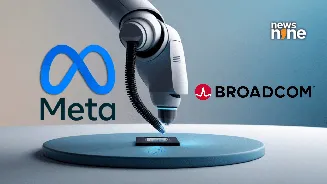









New Delhi: Meta has expanded its long-term chip partnership with Broadcom, locking in custom AI hardware development through 2029. The move comes as global
tech firms scramble to secure compute capacity for next-generation AI systems and reduce reliance on external GPU suppliers.
The announcement shows how aggressively Meta is investing in infrastructure. The company has already committed up to $135 billion towards AI this year, with a sharp focus on building its own silicon stack to support future workloads.
Meta scales custom silicon push with Broadcom
Meta said it will begin with an initial deployment of over 1 gigawatt of its MTIA chips, with plans to expand to multiple gigawatts over time. These accelerators are designed for both training and inference, supporting recommendation systems and generative AI tasks across Meta’s platforms.
In a statement, Mark Zuckerberg said, “Meta is partnering with Broadcom across chip design, packaging, and networking to build out the massive computing foundation we need to deliver personal superintelligence to billions of people.”
The chips are expected to use advanced 2-nanometer process technology, which could improve efficiency and help Meta scale faster.
Broadcom’s role expands beyond chip design
Broadcom’s role in the partnership goes beyond just silicon manufacturing. The company will support Meta across chip design, advanced packaging, and high-speed networking, which are critical for running large AI clusters.
Hock Tan said, “This initial MTIA deployment is just the beginning of a sustained, multi-generation roadmap to serve the trajectory of massive growth over the next few years.”
The collaboration is built on Broadcom’s XPU platform, which is designed to create custom AI accelerators tailored for specific workloads.
Shift away from traditional NVIDIA GPU dependence
Meta’s strategy reflects a broader industry trend. Companies like Google and Amazon have already invested in their own AI chips to manage rising costs and supply limits linked to GPUs.
Unlike its peers, Meta uses its MTIA chips internally to run its own services. This gives the company tighter control over performance, cost, and scaling, especially as AI workloads continue to grow.
Leadership changes and infrastructure expansion
As part of the development, Hock Tan will step down from Meta’s board and transition into an advisory role. He joined the board in 2024 and has played a key role in shaping the company’s silicon roadmap.
Meta is also expanding its physical infrastructure. The company plans to operate 31 data centres, most of them in the United States, alongside major deals involving Nvidia, AMD, and Arm-based chip designs.