


New Delhi: On board the International Space Station (ISS) are three free-flying Astrobee robots that use fans to move around. For the first time, the Astrobee robot has
used artificial intelligence to navigate the complex environment of the orbital complex with storage, wiring and hardware. The robot has to find the fastest path, as well as the most energy-efficient one, with safety being the priority. The researchers used an approach called sequential convex programming, where a complex problem is broken down into smaller, simpler steps, resulting in a final trajectory that is safe and feasible.
The team used a machine-learning model that trained on thousands of path solutions, providing the robot with foundational knowledge before further refinements, known as a warm start. The safety constraints are enforced by the optimisation technique, with the machine learning model helping the robot reaching the solution much faster. Before the AI was dispatched to space, the technique was evaluated at a special testbed, where the AI operated a robot similar to the Astrobee. When the AI was tested on the ISS, the pathfinding speed of the Astrobees increased between 50 and 60 per cent, particularly in the harder cases with cluttered areas, tight corridors, and manoeuvres that required rotation as against a straight path.
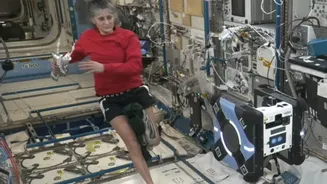
Sunita Williams conducted the experiments
The experiments were conducted by Sunita Williams, who prepared and cleaned up the Astrobee before stepping back and observing the autonomous manoeuvres in the Astrobee robots. The research was presented at the 2025 International Conference on Space Robotics (iSpaRo). Senior author Marco Pavone said, “The flight computers to run these algorithms are often more resource-constrained than ones on terrestrial robots. Additionally, in a space environment, uncertainty, disturbances, and safety requirements are often more demanding than in terrestrial applications.” Williams also evaluated a robotic gripper attached to the Astrobee for capturing simulated space debris.