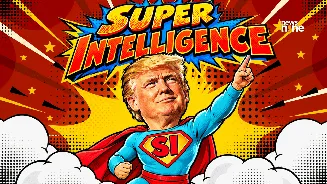









US President Donald Trump has directed federal agencies to use “Super Intelligence” instead of “artificial intelligence” as his administration deepens
its alliance with technology companies. The change was announced after a White House luncheon where industry leaders signed voluntary safety commitments and discussed data-centre expansion.
The new label is political branding, not a declaration that today’s systems have reached the technical idea called artificial superintelligence. Researchers normally use that term for a hypothetical machine that exceeds the best human abilities across every field. The White House usage covers the technology currently known as AI.
US President Donald Trump, Meta CEO Mark Zuckerberg, Google CEO Sunder Pichai, Elon Musk and other tech giants brief media after meeting on Super Intelligence pic.twitter.com/dcLpatwSxl
— ANI (@ANI) September 29, 2026
What is in the name, and why change it?
Trump has argued that “artificial” sounds fake and that “super” better captures the technology’s promise. He first promoted the change publicly before signing an order directing federal agencies to adopt the new wording. The label also supports his message that the United States should move quickly in its technology contest with China.
The rebranding arrives as public safety concern is rising. A Reuters and Ipsos poll conducted from September 17 to 20 found that 73 per cent of respondents believed AI companies had not done enough to prevent serious harm. Calling the technology “Super Intelligence” gives the administration a more positive frame while it resists measures that could slow development.
Great to meet today with @POTUS, @JDVance, @SpeakerJohnson and Administration + tech leaders. Important conversation and we signed today the White House Accord on Super Intelligence.
As I shared today, Google has invested hundreds of billions in the last two years alone, with… pic.twitter.com/04EirBfyUX
— Sundar Pichai (@sundarpichai) September 30, 2026
Tech leaders present
OpenAI president Greg Brockman, Anthropic chief executive Dario Amodei, Meta chief executive Mark Zuckerberg, Google chief executive Sundar Pichai and Nvidia chief executive Jensen Huang among the attendees. Elon Musk, Microsoft chief executive Satya Nadella, AMD chief executive Lisa Su and other technology figures were also present.
Trump described the companies’ agreement as being “almost like a constitution” and said it offered a form of protection. He also argued that self-regulation was important and suggested creating a 10-person board to watch over AI safety.
Zuckerberg said companies had agreed to establish robust internal controls. The accord also calls for independent audits, internal monitoring and board-level oversight, with safeguards intended to stop systems from hacking or accessing technical infrastructure in unintended ways.
#WATCH | US President Donald Trump says, “… Artificial Intelligence is like fake news… Fake news is one of my great terms, but now I’m going to call them (media) artificial news… This is why the SI, Super Intelligence, is — they’re saying — bigger than the industrial… pic.twitter.com/ANSGsN32Dd
— ANI (@ANI) September 29, 2026
What the ‘morally binding’ agreement does and does not do
The agreement is voluntary and was described as morally binding rather than law. It does not replace legislation, statutory regulators or enforcement powers. The administration also linked the initiative to faster data-centre construction, with companies expected to address local concerns over electricity demand, costs and community impact.
The name change may shape federal messaging, but it does not settle the debate over safety, competition or accountability.