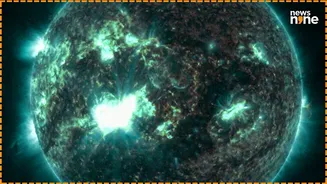



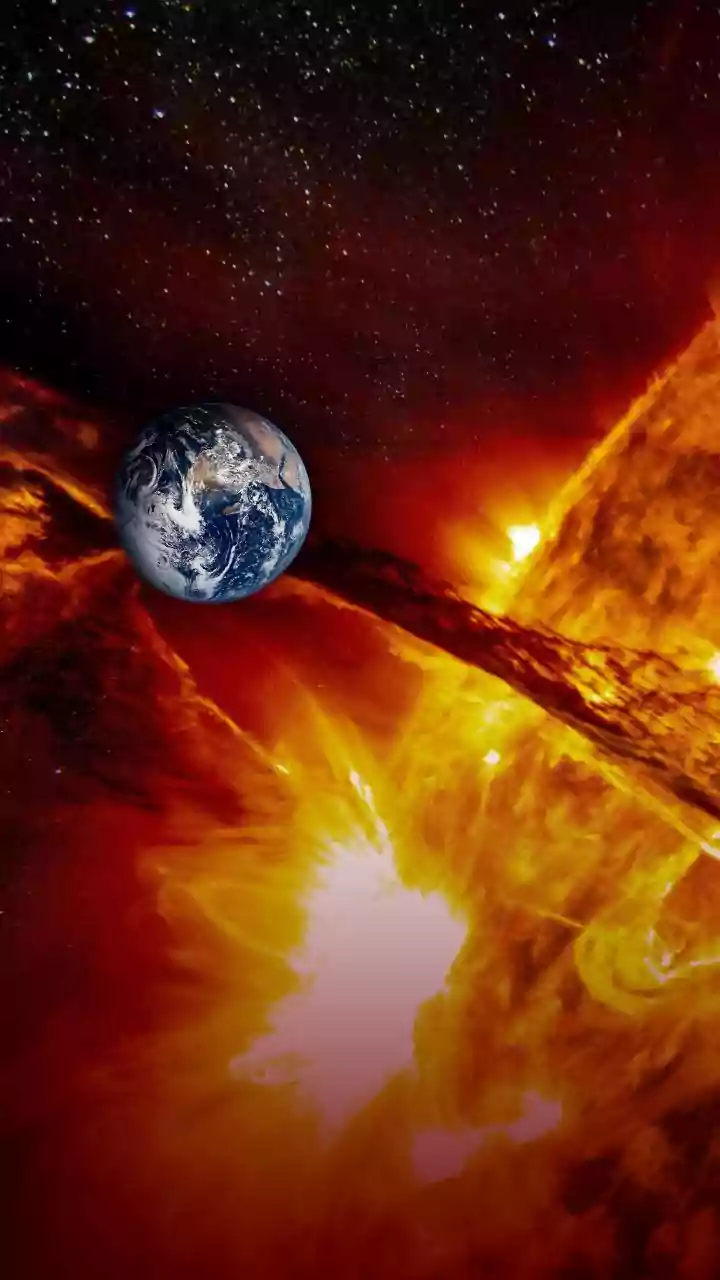



New Delhi: A long-duration X1.9 solar flare erupted from the Sun on 18 January 2026, peaking at 18:09 hours UTC. The flare erupted from a cluster of sunspots
designated as Sunspot Group 740 by the Solar Influences Data Analysis Centre (SIDC), operated by the Royal Observatory of Belgium and as Active Region (AR) 4341 by the Space Weather Prediction Centre (SWPC) operated by the US National Oceanic and Atmospheric Administration (NOAA). A number of small filaments near the active region were observed erupting and disappearing along with the flare. This is the first X-class flare of 2026, which is the strongest category of solar flares.

The alert issued by the SWPC. (Image Credit: NOAA).
The solar flare was accompanied by a full halo coronal mass ejection (CME), that is likely to be Earth-directed. This CME is estimated to be travelling at speeds between 1000 and 1500 km/s. The imagery from heliophysics observatories are still coming in, and analysis as well as modelling of the propagation of the CME is to be done. The arrival time and potential Earth impact will be communicated after the analysis. The active region is magnetically complex, has a high flare potential, and may erupt in more X-class flares. The active region is also aimed straight at the Earth, with any subsequent CMEs also likely to wallop the planet.
Space Weather Forecast
At the moment, there is a coronal hole on the Sun that is aimed straight at the Earth, with an associated High Speed Stream (HSS) disturbing the geomagnetic field. According to the forecast by the SWPC, “Enhanced solar wind conditions are expected to persist through 20 Jan as influence from a recurrent, positive polarity coronal hole will likely continue over the next three days. Additional enhancements are anticipated with the arrival of the halo CME, likely sometime on 19-20 Jan. Adjustments will be made to the forecast following the outcome of the modeling and analysis of the CME.”