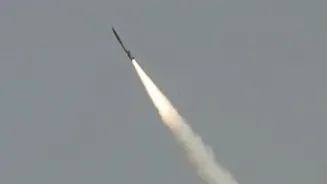








According to a report by The Japan Times on October 27, Japan Ground Self-Defense Force (GSDF) Chief of Staff General Masayoshi Arai confirmed that officials
had been dispatched to India. The discussions are still at an exploratory stage, and neither country has announced a formal agreement. Japan is looking for suitable locations where its military can practise using increasingly long-range weapons.
Read more: Explained: Who is Gadi Eisenkot? Ex-army chief who could be next PM of Israel
Why does Japan want to test missiles in India?
Japan faces a practical problem. Its newer missiles can travel hundreds of kilometres, making full-range training difficult within the country’s limited geographical space.
Testing such weapons requires large safety zones, controlled airspace and suitable maritime areas.
India has established military testing infrastructure and experience with long-range missile programmes, making it a potential partner.
General Arai described conducting training that takes advantage of the missiles’ extended range as “a major challenge.”
“We are currently examining this issue, including how to secure training environments domestically and, if necessary, how to utilize training environments overseas,” Arai said.
Read more: Cyclone Arnab hits Andhra Pradesh: Does El Niño play a role? Explained
What is Japan’s Type 25 anti-ship missile?
The Type 25 is a long-range surface-to-ship missile developed for Japan’s Ground Self-Defense Force.
Manufactured by Mitsubishi Heavy Industries, it is designed to target enemy warships from land-based launchers.
The missile has an estimated range of approximately 1,000 kilometres, compared with around 200 kilometres for Japan’s earlier Type 12 missile.
Japan deployed the Type 25 to Camp Kengun in Kumamoto Prefecture in March 2026.
The missile system was recently demonstrated during military exercises, though no missile was fired during that demonstration.
Read more: Aston Martin’s new Valhalla Spider can do 349 kph with the roof down
Japan is exploring attack drone testing too
The discussions extend beyond missiles.
Japanese officials are examining whether Indian facilities could support training involving smaller attack drones.
Such exercises require suitable testing areas, communication frequencies and safety arrangements.
No specific Indian facility has been publicly identified, and Japan has not confirmed which missile systems would participate in any future exercise.
Read more: Beware of MR ROBOT malware: Fake Aadhaar and KYC apps target Indian bank users
What does this mean for India-Japan defence relations?
India and Japan already cooperate through bilateral military exercises and the Quad partnership with the United States and Australia.
Both countries share concerns about growing Chinese military activity in the Indo-Pacific.
Allowing Japanese missile training in India could deepen operational cooperation and expand defence ties.