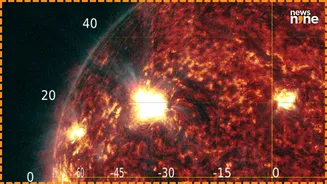







New Delhi: A short-lived but extremely powerful solar flare has erupted from the Sun, peaking at 23:57 UTC on 1 February 2025. This is the third strongest
flare of the ongoing solar cycle 25 after the X9 flare on 3 October 2024, and the X8.7 flare on 14 May 2024. The flare was associated with a cluster of sunspots designated as Active Region (AR) 4366 by the Space Weather Prediction Centre (SWPC) operated by the US National Oceanic and Atmospheric Administration (NOAA), and Sunspot Group 784 by the Solar Influences Data Analysis Centre (SIDC) operated by the Royal Observatory of Belgium. The flare resulted in a brief blackout of radio communications on the sunlit side of the Earth.

The alert issued by the SWPC. (Image Credit: NOAA).
Region 4366 is a large cluster of sunspots in the northeast quadrant that rotated into view a few days ago, and has grown rapidly magnetic complexity and size. It has been the source of a number of M-class solar flares, which is the second-highest category after X-class solar flares. Apart from the X8.1 flare, Region 4366 also erupted in an X 1.0 solar flare on 1 February at 12:33 UTC, about twelve hours before the X8.7 solar flare. The region is in the Early stages of its Earth-facing journey as it rotates from the east to the west throughout the week. If the region continues to evolve, it can erupt in additional solar flares.
Space Weather Forecast
According to the Center of Excellence in Space Sciences India (CESSI) hosted by the Indian Institute of Science Education and Research (IISER), Kolkata, “These strong flares are associated with magnetically complex active region 14366. Our analysis shows a rapid energisation and escalation of its flare productive parameters is ongoing. There is a high probability of flares and associated Earth directed CMEs over 48 hours.” According to the forecast by the SWPC, “Moderate to high solar activity is anticipated for the next three days. Region 4366 is expected to continue producting M-class flares and another X-class event would not be surprising.”