









What is the story about?
Two days before announcing the much-awaited ceasefire with Iran, US President Donald Trump had embarked on a profanity-laced tirade on Truth Social, warning Iran of dire consequences in case a deal is not reached by the said deadline.
"Tuesday will be Power Plant Day, and Bridge Day, all wrapped up in one, in Iran. There will be nothing like it!!! Open the F' Strait, you crazy b', or you'll be living in Hell," Trump wrote, triggering a sharp rebuttal from Congressmen across party lines, who demanded that he be removed from office.
While many have called for his removal even before, including the unprecedented two impeachments during his first term (2017-2021), this time around, another constitutional means has found the spotlight in the headlines. The legal tool in question is the 25th Amendment of the US Constitution.
Just like the much-talked-about First and Second Amendments, the 25th Amendment is also a change to the fundamental law under Article 5 of the US Constitution.
While impeachments through the US Congress, especially via the US House of Representatives, are a means to extricate the head of state of the US, the 25th Amendment, enacted in 1964, aids the removal of the President from office. As per this amendment, in case of his death or resignation, the Vice President shall become President.
While sections 2 and 3 of the amendment invoke the role of the US Congress (both Senate and House of Representatives) in the change of guards, these sections originate from the US president, and the initiation is from the 'Resolute Desk', as it is the president who does the needful in case of incapacity in discharging duties.
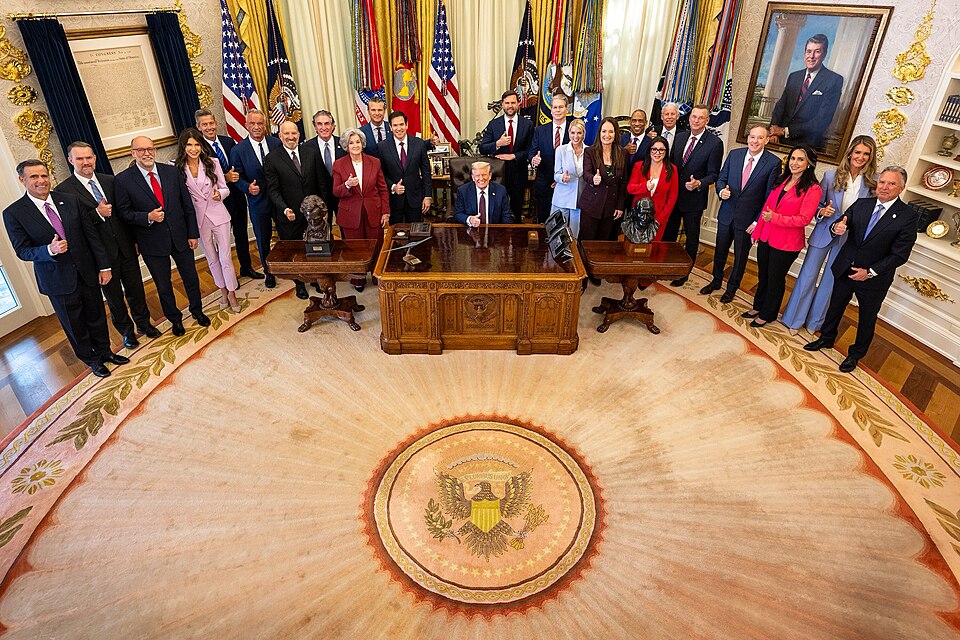
It is, however, the fourth section of the amendment that is being highlighted. As per this section, the role of the Vice President (in this case, JD Vance) and his cabinet comes into focus.
The section states, "Whenever the Vice President and a majority of either the principal officers of the executive departments or of such other body as Congress may by law provide transmit to the President pro tempore of the Senate and the Speaker of the House of Representatives their written declaration that the President is unable to discharge the powers and duties of his office, the Vice President shall immediately assume the powers and duties of the office as Acting President."
Here, the 'principal officers of the executive departments' are essentially the Secretaries of various departments. From Secretary of State Marco Rubio to Secretary of Transportation Sean Duffy, a majority of at least 12 secretaries can, through legal proceedings, effect a removal of the president without Trump's approval.
In the absence of the president, the US VP will discharge duties as Acting President until the US Congress decides upon the ability of the president to serve within 21 days of transmission of the written declaration.
Also Read: Copper rises as Trump's two-week Hormuz 'truce' allays some risk sentiment
"Tuesday will be Power Plant Day, and Bridge Day, all wrapped up in one, in Iran. There will be nothing like it!!! Open the F' Strait, you crazy b', or you'll be living in Hell," Trump wrote, triggering a sharp rebuttal from Congressmen across party lines, who demanded that he be removed from office.
While many have called for his removal even before, including the unprecedented two impeachments during his first term (2017-2021), this time around, another constitutional means has found the spotlight in the headlines. The legal tool in question is the 25th Amendment of the US Constitution.
What Exactly Is the 25th Amendment?
Just like the much-talked-about First and Second Amendments, the 25th Amendment is also a change to the fundamental law under Article 5 of the US Constitution.
While impeachments through the US Congress, especially via the US House of Representatives, are a means to extricate the head of state of the US, the 25th Amendment, enacted in 1964, aids the removal of the President from office. As per this amendment, in case of his death or resignation, the Vice President shall become President.
While sections 2 and 3 of the amendment invoke the role of the US Congress (both Senate and House of Representatives) in the change of guards, these sections originate from the US president, and the initiation is from the 'Resolute Desk', as it is the president who does the needful in case of incapacity in discharging duties.
Role Of Trump's Cabinet
It is, however, the fourth section of the amendment that is being highlighted. As per this section, the role of the Vice President (in this case, JD Vance) and his cabinet comes into focus.
The section states, "Whenever the Vice President and a majority of either the principal officers of the executive departments or of such other body as Congress may by law provide transmit to the President pro tempore of the Senate and the Speaker of the House of Representatives their written declaration that the President is unable to discharge the powers and duties of his office, the Vice President shall immediately assume the powers and duties of the office as Acting President."
Here, the 'principal officers of the executive departments' are essentially the Secretaries of various departments. From Secretary of State Marco Rubio to Secretary of Transportation Sean Duffy, a majority of at least 12 secretaries can, through legal proceedings, effect a removal of the president without Trump's approval.
In the absence of the president, the US VP will discharge duties as Acting President until the US Congress decides upon the ability of the president to serve within 21 days of transmission of the written declaration.
Also Read: Copper rises as Trump's two-week Hormuz 'truce' allays some risk sentiment