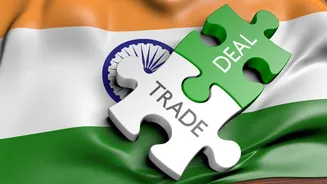







India and the European Union are likely to announce the conclusion and finalisation of negotiations of a free trade agreement on January 27.
The conclusion
of the FTA talks will be announced in the India-EU (European Union) Summit, news agency PTI reported citing government official.
The pact has taken 18 years to reach the finish line. Talks began in 2007 and have seen two prime ministers, multiple trade commissioners, and several abandoned rounds.
Commerce and Industry Minister Piyush Goyal has called it the "mother of all deals". European Commission President Ursula von der Leyen also reiterated the sentiments at Davos Summit recently.
The timing of the India-EU trade pact isn’t accidental as global trade is in churn after US tariffs nudged supply chains to redraw themselves, and Delhi and Brussels have chosen to lock in predictability.
European Commission President Leyen along with European Council President Antonio Costa, are in New Delhi for a four-day visit to attend the Republic Day celebrations on January 26. They will meet with Prime Minister Narendra Modi on January 27 for the summit.
Also Read: European Commission President Ursula von der Leyen lands in Delhi
The deal won’t be signed immediately. Legal vetting of the text will follow, and ratification will take its own path. For the EU, that includes its parliament. For India, the Union cabinet. Hence, the implementation of the deal may take some time.
Why is the deal closing now?
As with most FTAs, the arithmetic lies in duties. Over 90% of traded goods will see import duties reduced or eliminated. Labour-intensive sectors like textiles and footwear get the fastest relief—zero tariffs from day one. Other products will step down duties over five, seven or ten years, as per PTI.
Quota-based access, as seen in India’s pacts with Australia and the UK, will apply for autos and alcoholic beverages. Sensitive agri products will stay out.
Services see liberalisation as well—telecom, accounting, transportation, auditing—areas where India already outsources to Europe, and Europe outsources to India.
This will be India’s eighth trade pact since 2014, after Australia, the UK, Oman, New Zealand, the UAE, the EFTA bloc, and Mauritius. Older pacts—Asean, Japan, South Korea, Malaysia, SAFTA, and Singapore—set the precedent. But the EU deal is the biggest yet: 27 developed economies including France, Germany, Italy, Spain, and the Nordics.
The US has imposed tariffs as steep as 50%, rerouting trade and making diversification rational rather than ideological. India wants to cushion its exporters, reduce reliance on China, and access the EU market that takes 17% of India’s shipments. The EU sends 9% of its exports to India.
Read More: EU's tariff change could make Indian exports, especially textiles, less competitive: Ex-WTO envoy Dasgupta
In 2024-25, India-EU goods trade stood at $136.53 billion—$75.85 billion exports, $60.68 billion imports—making the EU India’s largest trading partner. Services in 2024 added $83.10 billion, as per PTI.
Europe’s GDP is $20 trillion with 450 million people. It exports $2.9 trillion and imports $2.6 trillion annually. India, with 1.4 billion people, exported $437 billion in goods and $387.5 billion in services; it imported $720 billion in goods and $195 billion in services.
Who gains more in market access?
India wants zero-duty access for textiles, leather, handlooms, and processed foods. The EU wants autos, wines, and high-tech access. Dairy, as always, is excluded to protect small farmers. The EU, for its part, keeps beef, sugar and rice ring-fenced.
India’s FY25 exports to the EU leaned on petroleum ($15B), electronics ($11.3B; smartphones $4.3B), textiles ($4.5B garments + $1.6B textiles), machinery and computers ($5B), organic chemicals ($5.1B), iron and steel ($4.9B), gems and jewellery ($2.5B), pharma ($3B), auto parts ($1.6B), footwear ($809M), coffee ($775M). Imports were led by machinery and computers ($13B), electronics ($9.4B; mobile parts $3.7B; ICs $890.5M), aircraft ($6.3B), medical devices and scientific instruments ($3.8B), gems and jewellery ($3B; rough diamonds $1.7B), organic chemicals ($2.3B), plastics ($2.3B).
Services follow a similar logic: India exports IT, telecom, transportation and business services; it imports IP services, telecom and IT.
EU firms have put $117.4 billion into India since 2000, forming 16.5% of total FDI with 6,000 European firms present. Indian FDI outflows to the EU total $40.04 billion.