







What is the story about?
SpaceX is trying to make its Falcon 9 rockets fully reusable and that can bring down the cost of sending satellites to space by a factor of 100, said Elon Musk.
Launched in 2010, Falcon 9 is launch vehicle that made its maiden commercial crewed flight to low earth orbit in 2020. The most significant breakthrough was SpaceX's ability to make reusable boosters that brought the cost down from to $62 million in 2018, a twentieth of what it used to cost the US space agency NASA earlier.
"We've now landed the boost stage over 500 times, but we have to throw away the upper stage. The upper stage burns up on reentry and the cost of that is equivalent to a small to medium sized jet," the billionaire founder of SpaceX explained while speaking at The World Economic Forum's annual gathering at Davos, Switzerland.
The price of heavy launches to low-Earth orbit (LEO) has fallen from $65,000 per kilogram to $1,500 per kilogram by 2021, according to an estimated cited by McKinsey, a consulting firm.
Falcon 9 is the cheapest among rocket providers who carry payloads. The Indian Space Research Organisation (ISRO), which is known to be a significant competitor, estimates the cost of launching polar satellite launch vehicle (PSLV) at about $4,500-5,000 per kg.
Guangzhou-based CAS Space's launches now cost about $6,900 per kg, China-based Yicai Global reported in October 2025.
India's private sector players like Skyroot and Agnikul rockets target $10-20 million for a 300 kg payload i.e. over $65,000 per kg, according to a News18 report in November 2025.
The collapsing cost of sending satellites is likely to boost space economy manifold. "Our analysts’ base-case forecast is for the satellite market to grow to $108 billion by 2035, up from the current $15 billion," Goldman Sachs said in March 2025.
The same report estimated that as many as 70,000 LEO satellites are expected to be launched over the next five years.
Read more: The turnaround in India's power utilities is still a work in progress
Launched in 2010, Falcon 9 is launch vehicle that made its maiden commercial crewed flight to low earth orbit in 2020. The most significant breakthrough was SpaceX's ability to make reusable boosters that brought the cost down from to $62 million in 2018, a twentieth of what it used to cost the US space agency NASA earlier.
"We've now landed the boost stage over 500 times, but we have to throw away the upper stage. The upper stage burns up on reentry and the cost of that is equivalent to a small to medium sized jet," the billionaire founder of SpaceX explained while speaking at The World Economic Forum's annual gathering at Davos, Switzerland.
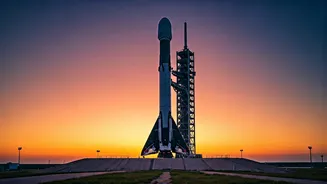
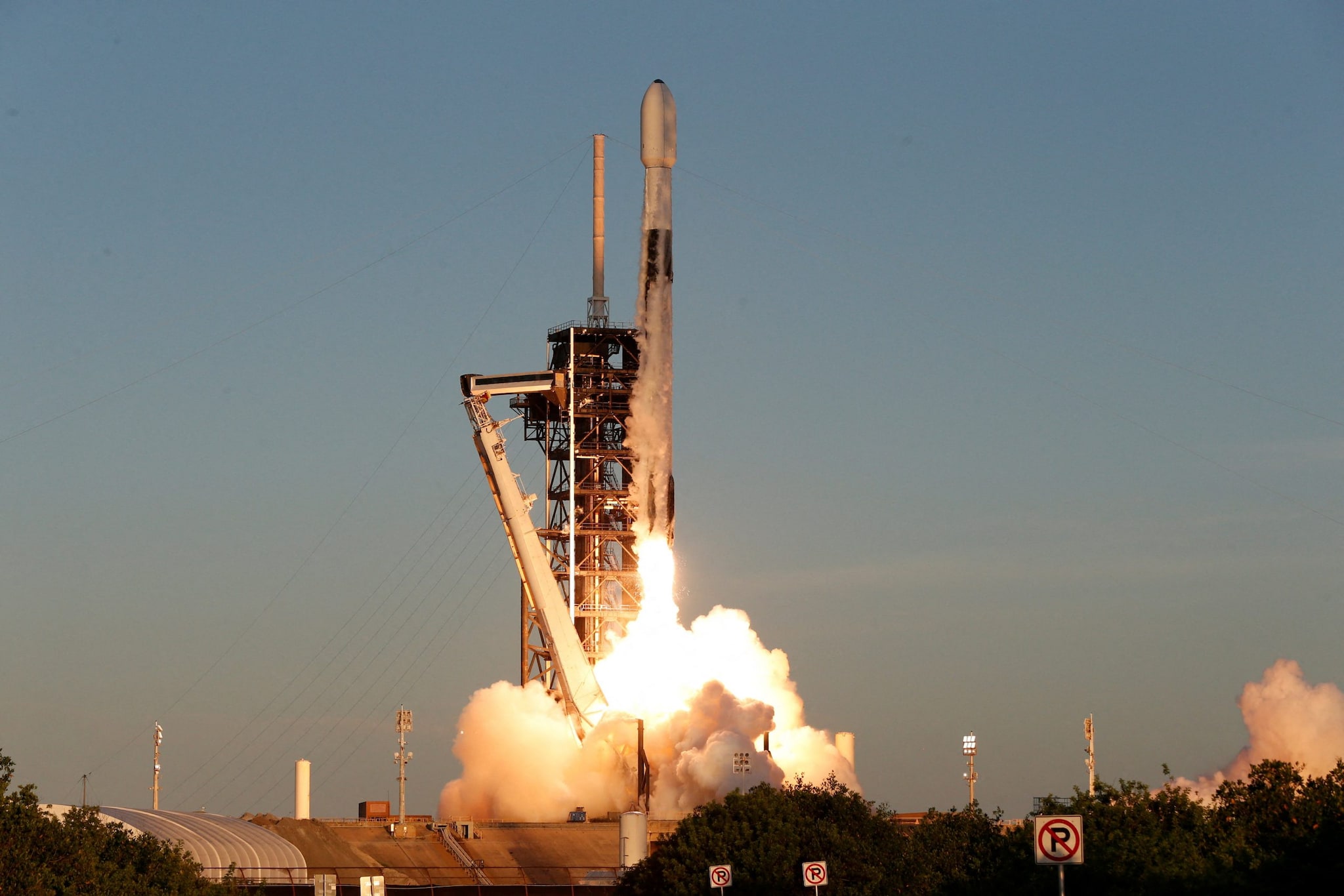
A SpaceX Falcon 9 rocket lifts off carrying NASA's Interstellar Mapping and Acceleration Probe (IMAP) mission, which is to study the boundary of the Sun's heliosphere, and other scientific payloads, at the Kennedy Space Center in Cape Canaveral, Florida, U.S., September 24, 2025. REUTERS/Joe Skipper
The price of heavy launches to low-Earth orbit (LEO) has fallen from $65,000 per kilogram to $1,500 per kilogram by 2021, according to an estimated cited by McKinsey, a consulting firm.
Falcon 9 is the cheapest among rocket providers who carry payloads. The Indian Space Research Organisation (ISRO), which is known to be a significant competitor, estimates the cost of launching polar satellite launch vehicle (PSLV) at about $4,500-5,000 per kg.
Guangzhou-based CAS Space's launches now cost about $6,900 per kg, China-based Yicai Global reported in October 2025.
India's private sector players like Skyroot and Agnikul rockets target $10-20 million for a 300 kg payload i.e. over $65,000 per kg, according to a News18 report in November 2025.
The collapsing cost of sending satellites is likely to boost space economy manifold. "Our analysts’ base-case forecast is for the satellite market to grow to $108 billion by 2035, up from the current $15 billion," Goldman Sachs said in March 2025.
The same report estimated that as many as 70,000 LEO satellites are expected to be launched over the next five years.
Read more: The turnaround in India's power utilities is still a work in progress