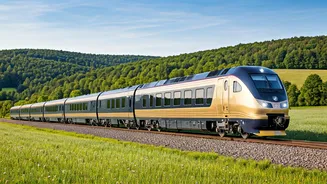

Japan's renowned bullet trains have long been the epitome of high-speed rail excellence, boasting an impeccable safety record and punctuality. Since its inception, these trains have solidified themselves as one of the most efficient and reliable railways across the world. Since the first line opened in 1964, the network has transported over 10 billion passengers without a single fatality in a crash or derailment.
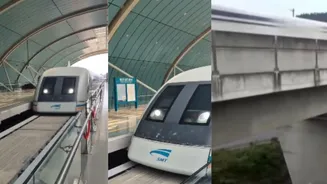
Now, the country is taking a giant leap forward with its next-generation Maglev train, leaving spectators in awe. A recent viral video showcased the train's breathtaking speed, with a reporter stunned into silence as it whizzed by at an astonishing 310 mph (nearly 500 km/h).
The Maglev train, developed by Central Japan Railway Company (JR Central) in collaboration with the Railway Technical Research Institute, is reportedly a part of the ambitious Chūō Shinkansen project. The reporter's reaction was priceless – a mix of stunned silence and uncontrollable laughter – as the superconducting magnetic train accelerated like a jet, passing by in a blink.
Sharing the video on Instagram, a user @mightynudge wrote, “Japan’s new $70 million Maglev train is so futuristic that even a seasoned reporter was left completely speechless after witnessing it in action. As the train glided past at 310 mph (nearly 500 km/h), it didn’t roar like a traditional locomotive— it hovered, whisper-quiet, floating on a cushion of magnetic force. No wheels. No friction. Just pure engineering magic.”
Social media users were equally impressed, with Instagram viewers flooding the comments with humour and disbelief. "If you blink, you might miss it," quipped one user. Others compared the train's speed to the fleeting nature of their salary, while some joked it was faster than the speed of light.
“It’s like my salary when it arrives in my account, and then it’s all gone,” another user said. “That’s faster than the speed of light. I doubt that,” a user posted. “How fast my weekend went,” an individual posted. “I think the train was racing the car under the bridge.That was going just as fast,” another wrote.
The Maglev train is being tested as part of the Chūō Shinkansen project, aiming to connect Tokyo and Osaka. Once completed, the line will feature a top speed of 500 km/h, reducing travel time between the two cities. However, the project has faced significant delays, with the launch now postponed until 2034 due to construction challenges.