When
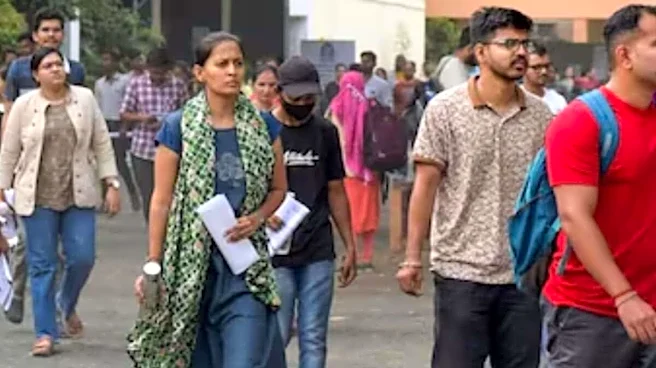
Prime Minister Narendra Modi announced on 26 July 2026 that he was handing India's troubled examination system to a single man, the choice surprised almost nobody who follows Indian public life. The country's worst NEET-UG paper leak had thrown lakhs of medical aspirants into turmoil, the youth-led Cockroach Janata Party had led protests across the country, and the education minister Dharmendra Pradhan had stepped down only a day earlier. Into that storm walked a familiar, unflappable figure in rimless glasses. For forty years, Nandan Nilekani has been the person India turns to when something enormous needs building.Also Read: Sir Gilbert Walker: Sent To Predict India's Monsoon, Found El Niño Instead
Who Is Nandan Nilekani?
Nilekani was born in Bengaluru in 1955 and trained as an electrical engineer at IIT Bombay. In his very first job, he met a colleague named N.R. Narayana Murthy, and in 1981 the two of them, with five others, founded Infosys. The company became the face of India's software boom, and Nilekani served as its chief executive from 2002 to 2007. Somewhere in the middle of a corporate career, he also became a writer, publishing 'Imagining India' in 2008, a book of ideas about the country's future that read less like a memoir than a blueprint, and which marked him out as a technologist who thought in terms of a nation rather than a company.
The Man Who Gave A Billion People An Identity
His defining work came next. In 2009, Prime Minister Manmohan Singh coaxed him out of the private sector to build something audacious, a unique digital identity for every resident of India. Nilekani stepped down from Infosys, took on the rank of a cabinet minister, and set up the Unique Identification Authority of India. The outcome was Aadhaar, the largest biometric identity system ever attempted, now covering well over a billion people and woven into everyday life, from opening a bank account to receiving a subsidy or buying a phone connection. It has drawn its share of debate over privacy along the way, yet as a feat of building at national scale, it has few rivals anywhere on earth.
A Life Built On Giving It Away
Away from the headlines, the more revealing story is what the Nilekanis have done with their fortune. His wife, Rohini Nilekani, is a former journalist turned author and one of India's most respected philanthropists in her own right. She wrote the medical thriller 'Stillborn' and the non-fiction 'Uncommon Ground', founded Arghyam to work on water and sanitation, and co-founded Pratham Books, which has put affordable storybooks into the hands of millions of children. In 2017, the couple signed the Giving Pledge, promising to give away at least half of everything they own.
The detail that matters most this week is quieter still. Back in 2014, Nandan and Rohini together founded EkStep, a non-profit that uses open technology to build basic literacy and numeracy among children who the formal system too often leaves behind. In other words, the man now asked to repair how India tests its young people has already spent more than a decade thinking, privately and at his own expense, about how they are taught in the first place.
Back Into The Fire
The task in front of him is unusually delicate. India's National Testing Agency runs the vast entrance examinations, NEET among them, on which millions of futures turn each year, and a run of leaks and irregularities has convinced students and parents alike that the system can be gamed. The six-member task force Nilekani now chairs is a heavyweight group, including the former ISRO chairman S. Somanath, the former Intelligence Bureau chief Tapan Deka, the IIT Madras director V. Kamakoti, the former school education secretary Anita Karwal and the senior administrator Amrit Lal Meena. Their brief is to rebuild the examination machinery around security, technology and transparency, and to make cheating on an industrial scale far harder to pull off.
Also Read: Who Is Gitanjali J Angmo? Sonam Wangchuk's Wife With a Corporate Career and a Mission In Education
What He Is Really Being Handed
The honest truth is that no clever piece of software alone will fix this, because the rot in the exam system is as much human as technical. What the appointment banks on is something less tangible than code. It is trust. Nilekani carries a reputation for calm, competent delivery at a size almost no one else in the country can match, the same reputation that once persuaded a doubtful nation that the state could build something that actually worked. Whether an identity number and an entrance exam are the same kind of puzzle is the open question. A billion people came to rely on the last thing he built. Millions of anxious teenagers, and the parents lying awake beside them, are now waiting to see whether the fixer can do it once more.
/images/ppid_a911dc6a-image-178513162108967010.webp)



/images/ppid_59c68470-image-178532505854466059.webp)





/images/ppid_59c68470-image-178532502776785886.webp)