/images/ppid_a911dc6a-image-177806722552453997.webp)




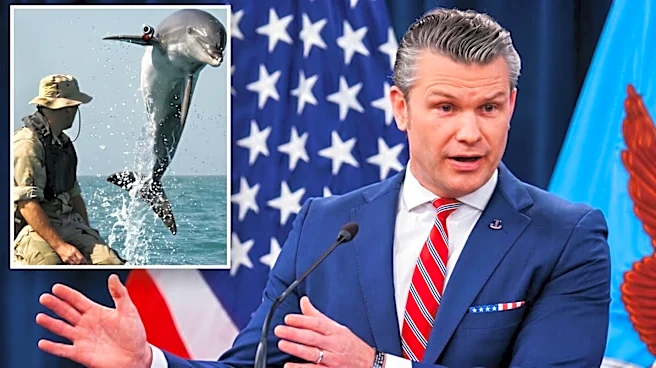
A Pentagon press briefing, earlier this week, unexpectedly veered into a territory that sounded less like geopolitics and more like satire. This happened when the officials found themselves addressing reports of Iranian 'kamikaze dolphins' and many observers likely assumed that they were hearing about science fiction. They were not entirely wrong but little did they know that the concept of weaponized marine mammals operating as suicide attackers has deeper roots in military history that most of us even realise. What Exactly Are Kamikaze Dolphins?Kamikaze dolphins, as described in recent intelligence reports, are basically trained bottlenose dolphins equipped with explosive devices and programmed to carry out suicide attacks against enemy naval
vessels. The term "kamikaze" is a reference from the Japanese World War II pilots who deliberately crashed explosive-laden aircraft into allied ships.Also Read: Pulitzer Winner Indian Journalist Suparna Sharma Speaks to Times Now Digital- ‘It Feels Unreal’Now, think of the aquatic version, where dolphins would theoretically be fitted with mines or explosive charges and trained to approach specific targets like enemy submarines, warships and even port facilities. The concept exploits the dolphin's natural intelligence, speed, and stealth capabilities, turning these marine mammals into living torpedoes. According to multiple reports, the training process involves conditioning dolphins to recognize certain acoustic signatures, visual markers. Once a target is located, the animal is trained to swim close enough for an explosive device to cause significant damage. The detonation is either triggered remotely or through a timer mechanism.The Soviet Blueprint This is not a new concept. The foundation for such programs actually goes back to the Cold War era when the Soviet Union developed extensive marine mammal military capabilities. Soviet trainers working out of facilities near Sevastopol in Crimea successfully taught dolphins to distinguish between friendly and enemy submarines based solely on the acoustic signatures of their propellers. Put in simplified terms, each submarine class produces a unique sound pattern that trained dolphins could learn to identify.According to declassified reports and accounts from former trainers, dolphins were equipped with harpoon-like devices, which were attached to their backs. These were trained to ram enemy divers, and yes, also prepared to carry explosive charges toward enemy vessels. The animals could dive to depths of several hundred feet, navigate in murky waters and also approach targets with a level of stealth which is nearly impossible for mechanical devices.When the Soviet Union collapsed in 1991, many of these military assets were abandoned or sold off. According to a 2000 BBC report, Iran acquired some of these trained dolphins, along with the expertise needed to maintain and expand such a program. Involvement Of US What makes this discussion more complicated is that the US has itself operated a marine mammal program for decades. The US Navy's Marine Mammal Program, which was established in the 1950s, trains bottlenose dolphins and California sea lions for naval operations. Their tasks include mine detection, underwater surveillance and identifying unauthorised divers near sensitive military sites.Also Read: Suvendu Adhikari: Inside the Simple Routine and Ground-Level Life of West Bengal’s High-Profile LeaderReportedly, these animals were deployed during the Vietnam war, the Iraq war and for harbour protection missions. However, the US Navy has consistently denied training dolphins for lethal attacks. Officials maintain that the animals are used strictly for detection and marking operations.What Is The Recent Controversy?The Pentagon discussion followed a recent Wall Street Journal report which claimed that Iran had at least explored reviving Soviet-era marine mammal programs. As per that report, these discussions allegedly involved dolphins trained to transport mines toward enemy ships in the narrow waters of the Strait of Hormuz. US Defence Secretary Pete Hegseth dismissed these reports. Alongside Hegseth, Chairman of the Joint Chiefs of Staff Dan Caine gave a quiet laugh and said, "Like sharks with laser beams, right?"However, the strategic logic behind such weapons is sound for a nation like Iran. Traditional naval confrontation with US forces would be futile given America's overwhelming maritime superiority. Kamikaze dolphins would theoretically allow Iran to threaten much larger vessels.




/images/ppid_59c68470-image-17780401181753514.webp)


/images/ppid_59c68470-image-177796566080387586.webp)
/images/ppid_a911dc6a-image-177796582739565432.webp)
/images/ppid_59c68470-image-177803256135915139.webp)