An obituary published in 1959 delivered a quiet verdict on the man it was mourning. His statistical method for forecasting the Indian monsoon, it noted, had not been a great success. Sir Gilbert Walker had spent two decades of his life on that problem, sifting weather records from every corner of the globe, and the profession's considered judgement was that he had not really cracked it. Ten years later, a Norwegian meteorologist in California pulled Walker's work off the shelf and used it to explain the single largest driver of year-to-year climate on Earth. Walker had been right the whole time. He simply did not live to hear anyone say so.Also Read: Who Is Gitanjali J Angmo? Sonam Wangchuk's Wife With a Corporate Career and a Mission In Education
The Famine That Started The Search
The story begins in catastrophe. Between 1876 and 1878 the monsoon failed over India, and the Great Famine that followed killed millions. The same climatic upheaval brought drought to China and Brazil in the same years, and the worldwide death toll ran into the tens of millions. It was, we now know, the strongest El Niño event ever recorded, though nobody then had any framework for such a thing.
What the disaster did produce was urgency. Henry Blanford, the Imperial Meteorological Reporter to the government of India, went looking for an explanation in atmospheric pressure records, and noticed that pressure had been strangely high not only over India but over great stretches of Asia and Australia. He wrote to Charles Todd, his counterpart in South Australia, who observed that droughts in India and Australia had a habit of arriving together. Something was linking weather across oceans. Nobody could say what.
A Mathematician In Simla
In 1904 the job of solving it fell to an unlikely candidate. Gilbert Thomas Walker was a Cambridge mathematician, a Fellow of Trinity, elected to the Royal Society that same year for work on dynamics. He had no training in meteorology. What he possessed was a formidable command of statistics and an appetite for problems others found intractable, along with a scholar's curiosity so wide-ranging that his study of the flight of the boomerang earned him a nickname at Cambridge.
Appointed Director-General of Observatories in India, he inherited a task that had defeated his predecessors, which was to forecast the monsoon on which hundreds of millions of lives depended. Walker approached it the only way he knew how. He gathered weather data from across the world, from Tahiti to Darwin to South America, and set his staff to the enormous labour of correlating it, all by hand, decades before any computer existed. He eventually identified twenty-eight predictors with stable historical relationships to the Indian monsoon, and divided the subcontinent into three forecasting regions.
The See-Saw Nobody Wanted
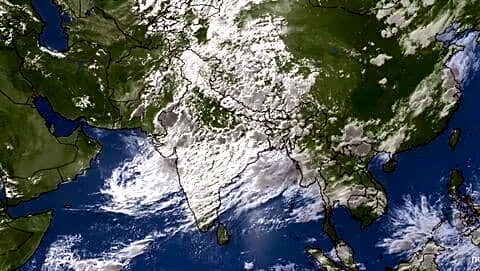
Buried in those correlations was something far bigger than the monsoon. Walker found that atmospheric pressure over the eastern Pacific and pressure over the Indian Ocean and northern Australia moved in opposition, rising on one side as it fell on the other, in a slow planetary see-saw. He named it the Southern Oscillation, and he showed that when the see-saw tilted a certain way, drought tended to follow in India and Australia.
The reception was cool. His fellow meteorologists distrusted a statistician's correlations without a physical mechanism to explain them, and Walker, to his credit, conceded that he could not prove why the pattern existed. He predicted only that the answer would emerge once scientists began measuring the atmosphere properly above ground level. He also warned, in 1927, of the danger of specialists in different fields growing up ignorant of one another's work, which turned out to be a fair description of what was about to happen to his own discovery.He was knighted on his retirement in 1924, took a professorship at Imperial College, and died at Coulsdon in Surrey on 4 November 1958.
Bjerknes Picks Up The Thread
In the 1960s, Jacob Bjerknes was trying to understand why the anomalies of the 1957-58 season had been so vast in scale. Peruvian fishermen had for generations called the warm current that arrived around Christmas El Niño, the Christ Child. Bjerknes realised that this warming of the Pacific and Walker's atmospheric see-saw were not two phenomena but one, an ocean and an atmosphere locked together. In 1969, eleven years after Walker's death, he set the mechanism out and named the east-west atmospheric circulation at its heart the Walker Circulation.
What The Records Kept
Also Read: How A Single Letter Took Ramanujan From Madras To Cambridge The India Meteorological Department went on using Walker's forecasting model until 1987, imperfect as it was. His name survives in the Yule-Walker equations, in the circulation Bjerknes named for him, and in every El Niño bulletin issued today, since the phenomenon is now known formally as the El Niño Southern Oscillation, the second half of that title being his. He never did produce the reliable monsoon forecast he was hired to deliver, which is what his obituarist chose to measure him by. Instead, while failing at the task in front of him, he had traced the outline of a rhythm that moves the weather of an entire planet, and left it in the records for someone with better instruments to find.
/images/ppid_a911dc6a-image-178479562932967495.webp)



/images/ppid_59c68470-image-178489002695741175.webp)