/images/ppid_59c68470-image-178953752744233488.webp)



What is the story about?
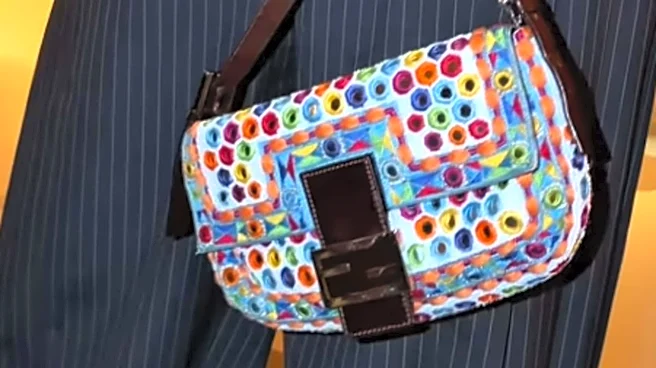
A Fendi handbag priced at around ₹8.3 lakh has sparked a debate on social media after industrialist Harsh Goenka compared its colourful mirror-work design to bags and accessories commonly seen in Gujarat during Navratri for ₹500.
Calling it the Fendi ‘Navratri’ bag, Goenka questioned why luxury brands use traditional Indian-looking designs without giving enough credit to the artisans and communities associated with them.
Sharing a picture of the bag on X, Goenka wrote, "After thePrada Kolhapuri chappal scandal, here comes the Fendi 'Navratri' bag. Charging ₹8.3 Lakhs for a design that looks exactly like a ₹500 bag available in the streets of Gujarat. And zero credit to Indian artisans. When will luxury brands stop colonising our crafts?"
Goenka's post on X also drew a response from Biocon executive chairperson Kiran Mazumdar-Shaw, who called the issue a case of ‘cultural appropriation’ and said Indian craftsmanship deserves recognition rather than imitation.
"This is a case of cultural appropriation & not in good taste. Repackaging India's traditional craft as luxury, without credit to the artisans who created and preserved it, undermines our authentic talent and heritage. Indian craftsmanship deserves recognition, not imitation," she wrote.
Fendi, though, has not called the handbag a ‘Navratri bag’. The product is officially listed as the Fendi Baguette 26424, a MulticoloUr Re Edition bag featuring embroidery, beads and mirrors.
According to Fendi, the bag is a re-edition of its original Baguette design from 1997 and has been brought back for the Fall/Winter 2026-27 collection. The bag is covered with hand embroidery and features 39,500 beads and 475 mirrors. Fendi says it takes more than 138 hours of craftsmanship to make. The brand lists it as made in Italy.
The colourful embroidery, mirrors and beads are what led many people online to compare the bag with traditional Indian mirror-work designs, especially those associated with Gujarat and Rajasthan. Such mirror work is also commonly seen in colourful festive clothing, bags and accessories sold in Indian markets.
The bag has sparked debate on social media.
One user wrote, "Let’s start calling it for what it is "PLAGIARISM" #StolenFromIndia. Need some litigations to start on these so-called unoriginal designer luxury brands. Recall, India was successful a few decades ago on stopping turmeric, basmati, neem on getting patented by Westerners."
Let’s start calling it for what it is “PLAGIARISM”#StolenFromIndia
Another wrote, "Why wouldn’t an Indian brand itself launch these?
"Why these small local makers are unable to sale as brand? These products shall be covered under one big umbrella brand @PMOIndia need to create brand?" another quipped.
The bag is connected to Chanakya, a Mumbai-based embroidery and craftsmanship house that works with international luxury fashion brands.
Harrods is currently hosting Fendi pop-ups from September 4 to September 26 as part of the launch of designer Maria Grazia Chiuri’s debut collection for the fashion house. Chanakya artisans are currently taking part in this programme and are showing embroidery and hand-crafted techniques on Fendi's Baguette and Peekaboo bags.
Calling it the Fendi ‘Navratri’ bag, Goenka questioned why luxury brands use traditional Indian-looking designs without giving enough credit to the artisans and communities associated with them.
Sharing a picture of the bag on X, Goenka wrote, "After thePrada Kolhapuri chappal scandal, here comes the Fendi 'Navratri' bag. Charging ₹8.3 Lakhs for a design that looks exactly like a ₹500 bag available in the streets of Gujarat. And zero credit to Indian artisans. When will luxury brands stop colonising our crafts?"
Goenka's post on X also drew a response from Biocon executive chairperson Kiran Mazumdar-Shaw, who called the issue a case of ‘cultural appropriation’ and said Indian craftsmanship deserves recognition rather than imitation.
"This is a case of cultural appropriation & not in good taste. Repackaging India's traditional craft as luxury, without credit to the artisans who created and preserved it, undermines our authentic talent and heritage. Indian craftsmanship deserves recognition, not imitation," she wrote.
Fendi, though, has not called the handbag a ‘Navratri bag’. The product is officially listed as the Fendi Baguette 26424, a MulticoloUr Re Edition bag featuring embroidery, beads and mirrors.
According to Fendi, the bag is a re-edition of its original Baguette design from 1997 and has been brought back for the Fall/Winter 2026-27 collection. The bag is covered with hand embroidery and features 39,500 beads and 475 mirrors. Fendi says it takes more than 138 hours of craftsmanship to make. The brand lists it as made in Italy.
The colourful embroidery, mirrors and beads are what led many people online to compare the bag with traditional Indian mirror-work designs, especially those associated with Gujarat and Rajasthan. Such mirror work is also commonly seen in colourful festive clothing, bags and accessories sold in Indian markets.
The bag has sparked debate on social media.
One user wrote, "Let’s start calling it for what it is "PLAGIARISM" #StolenFromIndia. Need some litigations to start on these so-called unoriginal designer luxury brands. Recall, India was successful a few decades ago on stopping turmeric, basmati, neem on getting patented by Westerners."
Let’s start calling it for what it is “PLAGIARISM”#StolenFromIndia
Need some litigations to start on these so called unoriginal designer luxury brands. Recall, India was successful a few decades ago on stopping turmeric, basmati, neem on getting patented by Westerners.
— NoFoolin (@MoushNau) September 15, 2026
Another wrote, "Why wouldn’t an Indian brand itself launch these?
"Why these small local makers are unable to sale as brand? These products shall be covered under one big umbrella brand @PMOIndia need to create brand?" another quipped.
The bag is connected to Chanakya, a Mumbai-based embroidery and craftsmanship house that works with international luxury fashion brands.
Harrods is currently hosting Fendi pop-ups from September 4 to September 26 as part of the launch of designer Maria Grazia Chiuri’s debut collection for the fashion house. Chanakya artisans are currently taking part in this programme and are showing embroidery and hand-crafted techniques on Fendi's Baguette and Peekaboo bags.


/images/ppid_59c68470-image-178990003062562986.webp)




/images/ppid_59c68470-image-178966503167718666.webp)