



What is the story about?
Every year on August 15, India celebrates its freedom from British rule, won in 1947. Flags are hoisted, songs are sung, and the whole country remembers
the long freedom struggle. But there is one Indian state that did not join this celebration in 1947 because it was not a British colony at all, and it was not free yet. That state is Goa! While the rest of India was ruled by the British, Goa spent over four centuries under a different European power: Portugal. Goa's own tryst with freedom came 14 years later, in December 1961. This Independence Day, here is the story of the one Indian state that never lived under the Union Jack.
A Colony Older Than British India
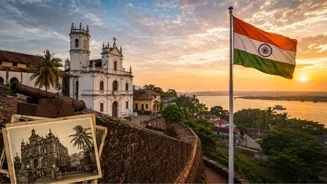
Goa's colonial story began long before the British East India Company set foot in India. The Portuguese began to rule in India two centuries before the British, first establishing a settlement in Goa in 1510. The man behind this conquest was Admiral Afonso de Albuquerque, who defeated the Sultan of Bijapur, Yusuf Adil Shah, to take control of the region. From then on, Goa became the centre of Portugal's eastern empire. It served as the capital of the entire Portuguese Empire.Also Read: Independence Day Special: India's Colonial-Era Railway Journeys You Can Still Take Today
Interestingly, the British and the Portuguese in India were not always two different stories. There were two brief phases, from 1797 to 1798 and again from 1802 to 1813, when British forces occupied Goa during the Napoleonic Wars, though the Portuguese continued to administer the territory throughout. Apart from this short military presence, Portuguese possessions in India remained largely undisturbed throughout the entire period of British rule in the subcontinent. In other words, Goa's coloniser never changed - it was Portuguese from 1510 all the way to 1961.
1947: Freedom For India, Not For Goa
When India became independent on August 15, 1947, Goa was still under Portuguese control. While most Indian territories were declared independent from colonial and other powers on that day, Goa remained under Portuguese power for over a decade after India's independence. Jawaharlal Nehru initially tried peaceful diplomacy to merge Goa into the Indian Union, but Portugal's dictatorship thwarted these efforts.This was not for lack of a Goan freedom movement. Tristão de Bragança Cunha, regarded as the father of Goan nationalism, founded the Goa National Congress at the Calcutta session of the Indian National Congress in 1928, and in 1946, socialist leader Ram Manohar Lohia led a historic rally in Goa demanding civil liberties and eventual integration with India. Over the following years, both peaceful satyagrahis and underground fighters kept up pressure. Armed groups such as the Azad Gomantak Dal and the United Front of Goans, supported by India, carried out sabotage and guerrilla attacks, while diplomatic efforts repeatedly failed as Portugal refused to negotiate or hold a referendum.
Operation Vijay And The 36 Hours That Ended 450 Years of Colonial Rule
Matters came to head in the late 1961 when tensions had been simmering for years but a violent incident turned out to be the final straw. On November 24, 1961, Portuguese forces fired at an Indian passenger vessel, killing one passenger and severely injuring several others. This sparked outrage across the country and pushed parliament towards taking a military action.On December 10, 1961, Nehru declared that the "continuance of Goa under Portuguese rule is an impossibility," while the United States made it clear it would not back Portugal if the matter reached the UN Security Council. Following this, the Indian armed forces launched their assault in the early hours of December 17-18, 1961. This operation was code named Operation Vijay. Around 30,000 Indian troops took part, backed by warships including INS Delhi and INS Mysore, which blocked any Portuguese reinforcements from arriving. Indian Air Force planes bombarded the airport and radio station at dawn, while the Indian Navy's frigates forced the Portuguese warship Afonso de Albuquerque to be beached near Marmagao port.
Also Read: Ahead Of Independence Day, India Expands E-Visa Entry Points To 88 Ports, Including Attari Border
The fighting was short and lopsided. Operation Vijay involved coordinated air, sea and land strikes over just 36 hours, ending 450 years of Portuguese rule, with Portuguese resistance overwhelmed by the far larger Indian force by the evening of December 18. Finally, all guns fell silent at 8:30 pm on December 19, 1961, when Governor-General Manuel António Vassalo e Silva signed the instrument of surrender, formally ending 451 years of Portuguese rule in Goa.
Since then, December 19 has been commemorated every year as Goa Liberation Day, marking the moment Goa, Daman and Diu formally became part of the Indian Union. Goa itself became a full-fledged state only later - it was initially a union territory before attaining full statehood on May 30, 1987.
Goa's story is a reminder that India's freedom struggle was not a single, uniform event but a mosaic of different fights against different colonial powers that ended at different times. Alongside the Portuguese in Goa, small French settlements also existed in the subcontinent and remained largely undisturbed throughout the period of British rule. Pondicherry and other French territories were merged into India in 1954, a few years before Goa. But Goa's Portuguese chapter, beginning in 1510, makes it unique - the region was never a British possession, and its freedom had to be won separately, through a mix of decades of civil resistance and, finally, a swift military operation in December 1961.