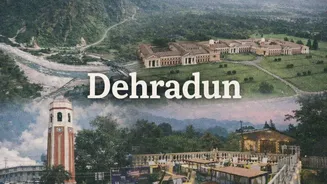

You don’t travel to Dehradun and instantly fall in love with it. Anyone expecting to be completely swept off their feet probably doesn’t understand the city
yet. Doon was never meant to dazzle. It reveals itself slowly. Yes, there are garden cafés tucked behind leafy gates, places with fairy lights, open lawns and menus that promise slow mornings and long conversations. There are new 'concept' cafes too, heritage bungalows turned into coffee spaces, bakeries that feel straight out of a Pinterest board, co-working cafes meant for people who have moved here chasing a quieter life. On the surface, it all looks charming, even Instagram-friendly. But step out of those cafes these days and the city tells a different story. Almost every road you take seems to be opening up into something new - another apartment complex, another builder floor, another under-construction promise of modern living. Turn a corner and you are greeted by hoardings and SALE signs splashed across gates and boundary walls. It’s hard to miss them. They are everywhere. Dehradun isn’t just growing, it’s being sold, piece by piece. There’s a constant dust hanging in the air, the kind that settles on your car and your skin. Construction dust, traffic dust, the residue of a city that is perpetually being dug up and rebuilt. During my visit, AQI readings fluctuated between 120 and 230 across different pockets, unsettling numbers for a place once synonymous with clean air and quiet living. The Mohand forest range, which once felt like a gentle, green welcome into Dehradun, has now been replaced by a long stretch of the newly opened Delhi–Dehradun expressway. Yes, it offers impressive glimpses of the hills. Yes, the drive is smoother, faster, you cruise at 100 instead of crawling along the old route. But for someone who has watched the forest slowly disappear, who has seen mountains being cut away for months on end to make room for this road, it’s hard to fully enjoy the scenery. It doesn’t feel the same. And it leaves you wondering, do we even deserve infrastructure that makes access to such places easier? Because more often than not, we respond by abusing it. We leave plastic behind, blast loud music, treat fragile landscapes like disposable backdrops. In the process, we turn places meant to offer calm and refuge into the exact opposite of what they are, deep down. Dehradun feels like it’s trying to shine, trying to survive, trying to live up to the hype. With better connectivity, it will soon be just a three-hour drive from Delhi. A dream for weekend travellers looking to escape the city, but increasingly a burden for a town that was never designed to absorb this kind of pressure. Over the past decade, green stretches have steadily made way for high-rise builder flats. There was a time when you didn’t have to drive far on the Dehradun–Mussoorie road to feel the true beauty of the hills. Now, you do. For a long stretch, even as your car climbs higher, the view feels strangely underwhelming, hills with bald patches, mountains interrupted by concrete and cuts that weren’t always there. Dehradun still has moments of calm. Early mornings are gentle. Evenings can be beautiful. But the city is caught between what it was and what it’s being turned into. And maybe the problem isn’t that Dehradun has changed, it’s that we are expecting it to be a hill station, a retreat, a quick-fix escape, without acknowledging the cost of that expectation.