





The world, as we experience it, is vast and often exhausting. Long-haul flights, endless road trips, itineraries that spill into spreadsheets, and holidays
that feel more like marathons than escapes. Yet, scattered quietly across the globe are a handful of countries that flip this idea of travel on its head. These are places where borders are crossed on foot, where “seeing the country” is not an exaggeration, and where size, quite literally, works in your favour. These nations may be small on the map, but they are fully sovereign, culturally rich, and historically layered. Getting to them may require effort, but once you arrive, their compactness becomes the luxury. With a sensible plan, comfortable shoes, and a willingness to wander, you can explore their key sights in a single day and still have time left to sit, sip, and simply absorb the atmosphere. Here are eight such tiny countries that prove you do not need acres of land to leave a lasting impression.
Vatican City
Do not let the word “city” mislead you. Vatican City is the smallest country in the world, covering just about 0.44 square kilometres. In theory, you could walk from one end to the other in under an hour. In practice, you will slow down almost immediately.
This is a country that holds some of the most recognisable art and architecture on the planet. St Peter’s Basilica, the Sistine Chapel, and the Vatican Museums are packed into a space smaller than many neighbourhood parks. Trivia worth knowing: Vatican City has no permanent hospital, no airport, and no prisons of its own, yet it operates as an independent state. Small in size, monumental in influence.
Monaco
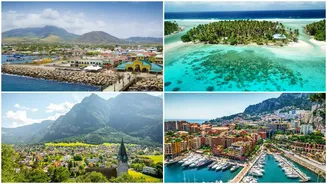
At just over two square kilometres, Monaco is living proof that a country does not need space to feel extravagant. Wedged between France and the Mediterranean, this tiny principality fits luxury hotels, royal palaces, a world-famous casino, and a Formula One racetrack into an improbably small area.
Walking through Monaco in a day is not only possible, it is pleasurable. You can move from the old-world charm of Monaco-Ville to the gloss of Monte Carlo with time left for leisurely coffee breaks. Fun fact: during the Grand Prix, everyday roads turn into one of the most challenging circuits in Formula One history.
Nauru
Covering roughly 21 square kilometres, Nauru holds the title of the world’s smallest island nation. A single coastal road loops around the entire country, making it feasible to see most of it in a single day.
Once one of the richest nations per capita due to phosphate mining, Nauru today is quiet, remote, and refreshingly slow-paced. Visitors encounter coral cliffs, limestone pinnacles, and remnants of World War II history, all within minutes of the ocean. It is not flashy, but it is fascinating in its isolation.
Tuvalu
With a land area of just 26 square kilometres, Tuvalu feels less like a country and more like a scattering of daydreams across the Pacific. The nation is made up of low-lying atolls, with most visitors spending their time on Funafuti, the capital.
There are no towering landmarks here. Instead, Tuvalu offers beaches, lagoons, village life, and endless skies. One day is enough to understand its rhythm and charm. An interesting detail: Tuvalu is one of the world’s least visited countries, receiving only a few thousand tourists annually.
San Marino
Entirely surrounded by Italy, San Marino is one of the world’s oldest republics and among its smallest, covering about 61 square kilometres. Perched atop Mount Titano, it feels like a medieval postcard brought to life.
The historic centre, a UNESCO World Heritage Site, is compact and walkable, with cobbled streets, stone towers, and sweeping views of the Italian countryside. The famous Three Towers dominate the skyline, and exploring them takes only a few hours. History feels dense here, concentrated rather than spread out.
Liechtenstein
At 160 square kilometres, Liechtenstein is larger than most on this list but still small enough to explore comfortably in a day. Nestled between Switzerland and Austria, this Alpine principality offers an impressive mix of scenery and culture.
Vaduz, the capital, is compact and charming, with museums, vineyards, and mountain views all within easy reach. Liechtenstein has no airport and no army, yet it maintains a strong national identity. With good planning, you can move from cultural sightseeing to nature walks in the same afternoon.
Marshall Islands
Spread across atolls but compact in population centres, the Marshall Islands cover about 181 square kilometres of land. Most visitors focus on areas such as Majuro, where daily life, history, and natural beauty converge.
Clear lagoons, coral reefs, and visible World War II relics define the experience. While island-hopping takes time, the core sights of the main atolls can be explored in a day. A lesser-known fact: the Marshall Islands were once the site of US nuclear testing, a history that still shapes the nation today.
Saint Kitts and Nevis
At 261 square kilometres, Saint Kitts and Nevis is the largest country on this list, yet still compact enough for a one-day overview. This two-island Caribbean nation blends colonial history with natural beauty.