





There's a new kind of travel envy spreading across Instagram and YouTube, and it doesn't involve Santorini sunsets or Eiffel Tower selfies. Instead, you'll
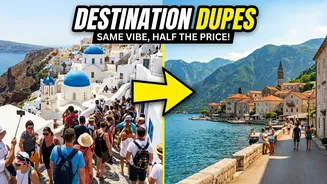
find cobblestoned alleys in Montenegro, lantern-lit streets in Vietnam, and pastel-painted riverbanks in Slovenia. Welcome to the era of the destination dupe, where the smartest travellers aren't following the crowd, they're quietly rewriting the map, which is light on their pockets and their hearts as well! The concept borrows directly from Gen Z's favourite shopping habit. In the same way 'dupes' replaced designer handbags with budget-friendly lookalikes, destination dupes replace overpriced, overtouristed hotspots with lesser-known alternatives that deliver the same atmosphere, culture, and beauty, often at a fraction of the cost. And in 2026, the trend has gone from niche travel hack to full-blown movement.
The Stats Back It Up
The numbers tell a striking story. According to financial platform Empower, swapping a marquee destination for its dupe equivalent can slash total trip costs by an estimated 30–50%, with travellers saving nearly $2,300 (₹2,00,000) on average. Meanwhile, Expedia's Unpack '26 report found that 63% of travellers are now actively seeking out less-visited destinations, a figure that would have seemed remarkable just five years ago.
But this is about far more than saving money. Generation Z, now the fastest-growing force in global tourism, is fundamentally rethinking what a good trip looks like. They're allergic to the performative, over-filtered, 'done-for-the-gram' travel of their predecessors. A survey by GetYourGuide, released in February 2026, confirmed that 38% of travellers choose dupe destinations specifically to save money, but an equal number cited a hunger for authentic, uncrowded experiences that major tourist traps simply can't offer anymore.
Read More: Planning a Trip to Shimla? Best Time to Visit, Weather Updates and Travel Tips
The hashtag #dupe has racked up more than 6.5 billion views on social media platforms, and the travel variant is one of its fastest-growing subcultures. Hotel transaction data from one major credit card network shows bookings at dupe destinations running 9% higher than at their better-known counterparts. The shift isn't marginal. It's structural.
The Popular Dupes
The dupe list that has dominated travel discourse this year reads like a parallel atlas: Ljubljana instead of Paris, Kotor instead of Dubrovnik, Hoi An instead of Kyoto, Albania instead of Greece or Turkey. These aren't consolation prizes, many travellers return insisting the dupe was the better trip. Medellin, Colombia, swapped for Barcelona, offers warm weather year-round with a cultural renaissance story. Hoi An, Vietnam, trading in for Kyoto, delivers lantern-lit canals, ancient merchant houses, and daily expenses that average $30 to $45, versus Kyoto's $140-plus.
There's an irony at the heart of this movement that nobody misses. The very places Gen Z is fleeing, Venice, Rome, Santorini, were once someone else's hidden gems. Overtourism has turned them into human traffic jams with entry fees. One in four French travellers now explicitly choose alternatives specifically to avoid contributing to that cycle. The dupe trend, at its most idealistic, is also a quiet act of sustainable travel, redistributing tourist dollars to communities that actually benefit from them.
That said, the window narrows fast. Albania, once the ultimate dupe for Greece, is already seeing prices tick upward as the secret gets out. The very act of naming a dupe destination on social media begins the countdown to its own overtourism. Which is, perhaps, why the most committed Gen Z travellers keep their favourite dupes to themselves, a radical act in the age of the hyperlinked everything.
What's certain is that this generation is travelling smarter, not less. A Skyscanner survey found 52% of Gen Z plans to increase overseas trips in 2026. They're not cancelling the dream, they're redrafting it, passport in one hand, phone in the other, searching for the place that hasn't been ruined yet. And finding, more often than not, that it's even better than the original.
Read More: Your Ultimate Northern Lights Dream Might Get A Little Expensive As Finland Plans To Introduce Tourist Tax Soon