







What is the story about?
We hit Pench National Park at dawn, the jeep's growl slicing through mist-shrouded teak forests–the very muse for Kipling's The Jungle Book. Lush bamboo,
Wainganga's lazy bends, pristine meadows: this Madhya Pradesh wild, just two hours from Nagpur airport, birthed Mowgli's world. No time for backstory; wildlife waits for no one.
First Safari: Bija Matta's Gaze
Pench National Park grips you from the first glimpse: 758 square kilometers of Madhya Pradesh wilderness straddling the Seoni and Nagpur districts, where mixed deciduous forests of towering teak and dense bamboo frame the serpentine Wainganga and Kanhan rivers. Pristine meadows burst with wildflowers in monsoon aftermath, rocky kopjes punctuate the horizon, and perennial streams carve gorges teeming with life. Rudyard Kipling mined this exact landscape for The Jungle Book–its "Seeonee" hills echo Pench's own, birthing Mowgli, Shere Khan, and Baloo. Accessible like few Indian parks, it draws dreamers yearly to chase those characters in flesh: Royal Bengal tigers prowling 100-plus strong, leopards in rocky haunts, and elusive dholes (aka wild dogs), whose packs have dwindled to numbers far less than tigers.Every safari inside Pench starts with an intro to the park's matriarchs, out of which one is legendary: Collarwali. This "supermom," reigned till 2022, raising 29 cubs in her 14 years with tactical genius, her radio-collared saga swelling Pench's tigers by half as offspring claimed vast territories. Birds dazzle too: over 300 species, from racket-tailed drongos to paradise flycatchers, make this national park a birder's Eden.
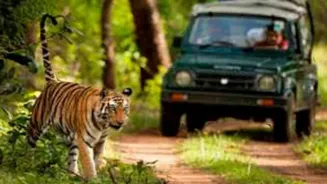
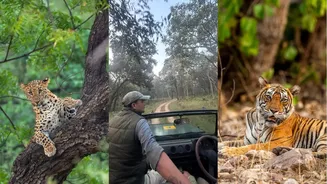
On our journey, we keep our eyes peeled for tigers, and eventually track Bija Matta, another local legend of sorts, who is on the prowl with her ‘sub-adult’, who threatens to overshadow her in height in just a few months. They cross our thicket of jeeps with ease before disappearing once again into the dense forests of Kipling.
The Hours Between Safaris
What stays with you in Pench are not just the drives, but the hours in between, when the heat peaks and you retreat from the sun. Where you stay matters less for luxury and more for proximity to this rhythm.
Our base for the two days we spent here is Pench Tree Lodge, an outpost run by Pugdundee Safaris, spread across 40 acres in the Karmajhiri area of Pench National Park. It's the first resort in Pench to be set up in this underdeveloped zone, and almost an extension of the forest you’d find hard not to be enamoured by.
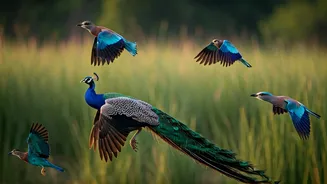
Here, the forest never quite recedes. Even during the day’s lull, there’s movement at the edges: langurs announcing visitors, cicadas filling the air, peacocks calling somewhere beyond sight, and an occasional tiger that prowls the fence-less corridors of the retreat. Save for birdsong and wild boars, there is silence here, which comes as a relief for someone from Delhi, who has gotten so accustomed to incessant honking that it is also white noise. Whether you choose to stay in one of the 10 cottages or the six tree houses that Pench Tree Lodge boasts, chances are you’ll spend most of your idle time on walking trails around the property. And for birders and photographers alike, the piece de resistance is the Kipling Photography Hide.
Designed for four photographers, the space is practical rather than precious, with professional beanbags positioned for long hours and a simple coffee station and fridge within reach. On really good days, I am told, honey badger and leopard pass through too. Whether they do or don’t almost becomes beside the point. From the hide, you’re not chasing sightings; you’re watching interactions unfold, undisturbed.
Second Safari: Leopards, Kala Pahad, And Dhole Ecstasy
Day two brings our second and last safari of Pench, and our runs continue in the company of Omkar Bhatt, Pench Tree Lodge’s manager who doubles up as our naturalist and gypsy expert. He regales us with tales of Pench, stopping occasionally to inquire about sightings, and to show us the forest, which is, as it turns out, as famous for leopards as it is for tigers.
We get lucky a few minutes later, as a leopard mom crowns rocks with her cubs monkeying around the branches, pouncing, wrestling, and tails lashing in gleeful chaos. Her watchful eyes scan us; it is pure family theater.
Then frenzy ensues as dozens of jeeps clog a clearing. Kala Pahad, another tigress who, Omkar tells us, likes to take long walks to mark her territory, saunters through, utterly unfazed. She flicks her tail high, muscles undulating, parting the crowd like mist. Another tigress, queenly amid admirers. This brings our Pench sighting to five tigers total, three leopards. But I am hungry for rarities, especially after learning about dholes.
Dholes, also known as Asiatic wild dogs, are among India’s most elusive and fascinating predators. Found mainly in forests across central, southern, and northeastern India, they thrive in protected reserves such as Pench, Tadoba, Nagarhole, Bandipur, and parts of the Western Ghats. Highly social animals, dholes live and hunt in coordinated packs, relying on teamwork rather than brute strength to bring down prey that often outweighs them. From a distance, they look like a mix of wolves and dogs.
Hopes peak on the empty track, golden light pooling. And just like that, six dholes cavort right on the road where it is just us. They chase tails, tumble, yip in pack rapture, rarer than tigers now, Kipling's wolves alive in russet fury. We stay for 20 minutes before the family decides to leave our path, stealing a last look at us before going their way. “Despite being efficient hunters and playing a crucial role in maintaining ecological balance, dholes are endangered due to habitat loss, declining prey, disease transmitted from domestic dogs, and human disturbance,” Omkar tells us as we begin our journey back to the main gate.
Also Read: Pench National Park: Zones, Best Time To Visit And More About The Wild Heart of Madhya Pradesh
The romance of Kipling’s jungle stories is never far away in Pench, but the reality is more complex and far less forgiving. Between sightings, the conversation often turns to coexistence–villages at the forest edge, grazing pressures, and the fragile line between protection and conflict. That tension follows you back to the lodge, where dinner near the organic garden is unhurried and reflective. It’s impossible not to think about how close this forest runs to human life, and how much effort it takes to keep it standing.
While we talk, plans are being chalked out to move another village from the periphery of the national park to give more space to wildlife for conservation. It is a tightrope, one that has to be walked very carefully. Each side needs, and deserves, to be thought about. Later, sitting by the bonfire under a full moon, cicadas filling the dark, it becomes clear to me that while tourism sustains places like Pench, the greater responsibility of the visitor is knowing when to step back. To arrive with wonder, and to leave without entitlement.
Also Read: Where Tiger Is God: Inside Tadoba’s Forest of Shrines And Safaris