
India's 80th Independence Day is just around the corner! Every year around this time, we talk about the same handful of names and places - Red Fort, Gandhi,
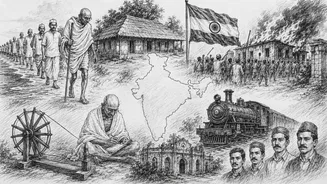
the tricolour going up on the 15th of August. But independence was not won in one city or by one big event. It was built, slowly and painfully, in small villages that most of us have never even visited and barely remember. Here is a look at some of them. Dandi, Gujarat Dandi happens to be a coastal village in Gujarat, and it would have stayed unknown to most Indians if Gandhi had not walked 24 days and nearly 390 kilometres to reach it in 1930. He came here to break the British salt law, picking up a handful of salt from the beach as a simple act of defiance. It sounds small, but that walk - the Dandi March - became one of the biggest mass movements against British rule. Thousands joined him on the way, and thousands more broke the salt law in their own towns after hearing about it. Today Dandi has a memorial and a museum called the National Salt Satyagraha Memorial, built along the same route Gandhi walked. Also Read: Air India Turbulence Scare: 17 Injured On Phuket-Delhi Flight; Can It Really Bring Down A Plane? Here Are Safety Rules Every Passenger Should Follow Sevagram, Maharashtra Sevagram means "village of service," and that is exactly what Gandhi wanted it to be. In 1936, he set up his ashram here, near Wardha, and made it his base for the rest of his life until 1948. This was not just where he lived, it was also where he worked out his ideas on self-reliance, khadi, village industries, and basic education. Leaders from across the country came here to meet him, including during the Quit India Movement planning in 1942. The ashram still stands, simple mud huts with thatched roofs, nothing grand about it. And that's the whole point. Gandhi believed real change had to start in villages like this one, not in big cities, and Sevagram was his proof of that idea in practice. Chauri Chaura, Uttar Pradesh Chauri Chaura tells a completely different kind of story. In February 1922, a large group of protesters clashed with police here, and the situation turned violent. A police station was set on fire and over twenty policemen died. At that time, Gandhi was also running the Non-Cooperation Movement and this incident went against everything he stood for. He called off the entire movement within days, even though it was gaining huge momentum. This was a controversial decision then and is still debated now. But it also shows how seriously non-violence was taken as a principle. Kakori, Uttar Pradesh Kakori is a small village near Lucknow, and on one August night in 1925, it became the site of one of the most daring acts of the revolutionary freedom movement. A group of young men, including Ram Prasad Bismil and Ashfaqulla Khan, stopped a train and looted government money which was meant for British treasury. They were in a hope to fund arms for an armed uprising. The aftermath, however, was harsh. Most of them were caught, tried and hanged. Unlike Gandhi's satyagraha, Kakori represents the other side of the independence movement, the one that believed force was necessary against British rule. Also Read:Glaw Lake Becomes Arunachal Pradesh's First Ramsar Site, Marking a Major Wetland Conservation Milestone These villages don't get much attention compared to the bigger cities and monuments, but each one played its part in getting India to 1947. As the 80th Independence Day approaches, they are worth remembering - and maybe even worth visiting.