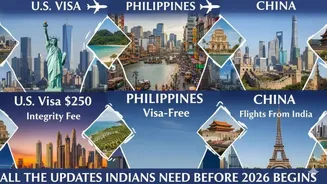
International travel for Indians is entering a new phase. Over the past year, visa policies have shifted rapidly—opening doors in some countries while
raising costs and scrutiny in others. As Indians plan holidays, workcations, study abroad stints, and long-stay travel for 2026, understanding these updates is no longer optional. From the United States introducing a new $250 visa integrity fee to Southeast Asia expanding visa-free access, here’s a comprehensive look at the most important visa and travel updates Indians need to know.
THE BIGGEST VISA UPDATES FOR INDIANS
US Visas Are More Expensive, & More Closely Scrutinised
Travel to the United States has become significantly costlier. A new $250 “visa integrity fee” now applies to most non-immigrant visa categories, including tourist (B1/B2), student (F, J), and work visas (H1-B and related categories). This fee is charged in addition to existing visa costs, pushing the total cost for Indian applicants to over $400 in many cases.
At the same time, the US has tightened procedures:
Social media vetting is now mandatory for student and exchange visa applicants, with profiles required to be set to public.
In-person passport collection has become compulsory, with limited exceptions.
Visa interview waivers have been narrowed, signalling longer processing times.
For Indians planning US travel, study, or work in 2026, earlier applications and higher budgets are now essential.
The Philippines Goes Visa-Free For Indians
In a major boost for Indian outbound travel, the Philippines introduced visa-free entry for Indian passport holders in 2025. Indians can now enter visa-free for 14 days for tourism, with an extended 30-day stay available for travellers holding valid US, UK, Schengen, or other select visas. This makes the Philippines one of the most accessible Southeast Asian destinations for Indians—particularly for short holidays and island-hopping trips—and positions it as a strong alternative to Thailand or Bali.
Palau Becomes Visa-Free For Indian Travellers
The island nation of Palau has added India to its visa-free list, allowing Indians to stay for up to 30 days without a visa. While direct flights from India are not yet available, Palau is reachable via hubs such as Manila, Singapore, Seoul, and Taipei. For Indian travellers looking beyond mainstream beach destinations, Palau’s coral reefs, marine biodiversity, and low tourist density make it a compelling offbeat option for 2026.
China Flights From India Resume
Air connectivity between India and China is improving steadily. Multiple new and expanded routes—including Delhi–Guangzhou, Kolkata–Guangzhou, and daily non-stop Delhi–Shanghai services—are restoring travel links that were disrupted for years. These developments simplify travel for Indian students, business travellers, and tourists planning China trips in 2026, especially to major commercial and academic hubs.
New Zealand Allows Remote Work On A Visitor Visa
New Zealand has introduced one of the most flexible remote work options for Indians. Under updated rules, Indian travellers on a Visitor Visa can now work remotely for foreign employers for up to 90 days, without applying for a separate digital nomad visa. There is no stated minimum income requirement, making this an attractive option for freelancers, consultants, and remote employees planning extended stays.
Slovenia Launches A Digital Nomad Visa
Slovenia has joined Europe’s growing list of digital nomad destinations, offering Indians a one-year non-renewable digital nomad visa. Eligible applicants must work for companies or clients outside Slovenia. As a Schengen member, Slovenia also allows visa holders to travel freely across much of Europe, making it a strategic base for long-term European stays.
Switzerland Offers a Golden Visa Route for Indians
For high-net-worth Indians, Switzerland has opened a Golden Visa pathway to residency through investment or lump-sum taxation. The programme offers long-term residency, Schengen access, and a route to permanent residence and citizenship over time.
New Zealand Introduces A Long-Stay Parent Visa
The newly announced Parent Boost Visa allows parents of New Zealand residents to stay for up to 10 years, making long-term family visits significantly easier for Indian migrants and professionals based in New Zealand.
Argentina Opens Visa-Free Entry for Indians With US Visas
Indian passport holders with valid US tourist visas can now enter Argentina without applying for a separate Argentine visa. This simplifies travel to South America and could encourage more Indian travellers to explore the region beyond traditional routes.
GCC Grand Visa Could Transform Middle East Travel
Expected to launch this month, the GCC Grand Visa aims to allow travellers to visit six Gulf countries using a single visa, similar to the Schengen model. If implemented, this could dramatically simplify travel across the Middle East for Indian tourists. So far, it is going to be launched for GCC nationals but could soon let you also visit countries like UAE, Saudi Arabia, Bahrain, Qatar, Oman, and Kuwait using a single visa.