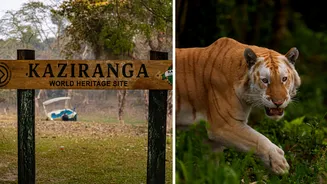








If you’ve been scrolling through Instagram lately, chances are you’ve paused at least once for that tiger. The unusually light coat. The soft, pale stripes.
That almost glowing golden colour that looks too perfect to be real. A lot of people are assuming it’s a brand-new species or some once-in-a-lifetime discovery. It isn’t. But the truth behind it is still fascinating and a little misunderstood. This tiger’s appearance comes from a rare genetic trait, not from being a separate species. Known informally as a golden tiger, its colouring is the result of a recessive gene that affects how pigment is expressed in the fur. Because of this, the usual deep orange fades into a creamy golden shade, and the black stripes appear lighter and less defined. In simple terms: the tiger is rare because of how it looks, not because it belongs to a new or unknown group of tigers.
Where Was It Spotted?
Earlier this year, in April, a golden tiger was sighted in Kaziranga National Park, Assam — a moment that immediately caught the attention of wildlife lovers and conservationists alike.
India recorded its first golden tiger in 2014, and sightings since then have been very rare.
Kaziranga already holds global recognition. A UNESCO World Heritage Site, it’s best known for protecting the world’s largest population of one-horned rhinoceroses, along with an extraordinary variety of birdlife. Seeing a golden tiger here feels almost surreal, especially considering how dense the park’s grasslands and forests are.
Why Visit Kaziranga National Park?
Kaziranga isn’t the kind of place you rush through with a checklist. It’s slower, quieter, and a little unpredictable — in the best way.
Most visitors arrive with rhinos in mind, but the park reveals itself gradually. Early-morning mist hangs over tall grass. Light shifts constantly as clouds move. You can explore by jeep, experience an elephant safari, or skip vehicles altogether and spend hours birdwatching or sitting quietly near water bodies.
What Can You See at Kaziranga?
Beyond the famous rhinos, Kaziranga supports an impressive range of wildlife. Tigers, wild water buffaloes, elephants, and swamp deer roam the park, though encounters depend heavily on timing and sheer chance.
Smaller mammals like otters, hog deer, fishing cats, and porcupines are part of the ecosystem too. Along the Brahmaputra, Gangetic river dolphins surface often enough to feel like a quiet reward for patient observers. And for bird enthusiasts, the diversity here means no two visits ever feel the same.
Every trip to Kaziranga offers something different — sometimes dramatic, sometimes subtle. And occasionally, if luck truly decides to favour you, something as unexpected as a golden tiger.
Which zones are the best at Kaziranga National Park?
Kaziranga is split into four zones, and each feels very different once you’re inside. Agoratoli, on the eastern side, is loved for calm early-morning safaris, when birds are active and elephants are often seen moving through the mist. Kohora sits at the centre and is usually the busiest zone, mainly because rhinos are spotted frequently and tigers are seen here more often than elsewhere. Bagori’s open grasslands make sightings easier, especially for rhinos. Burapahar, far quieter, is better known for gibbons and capped langurs.